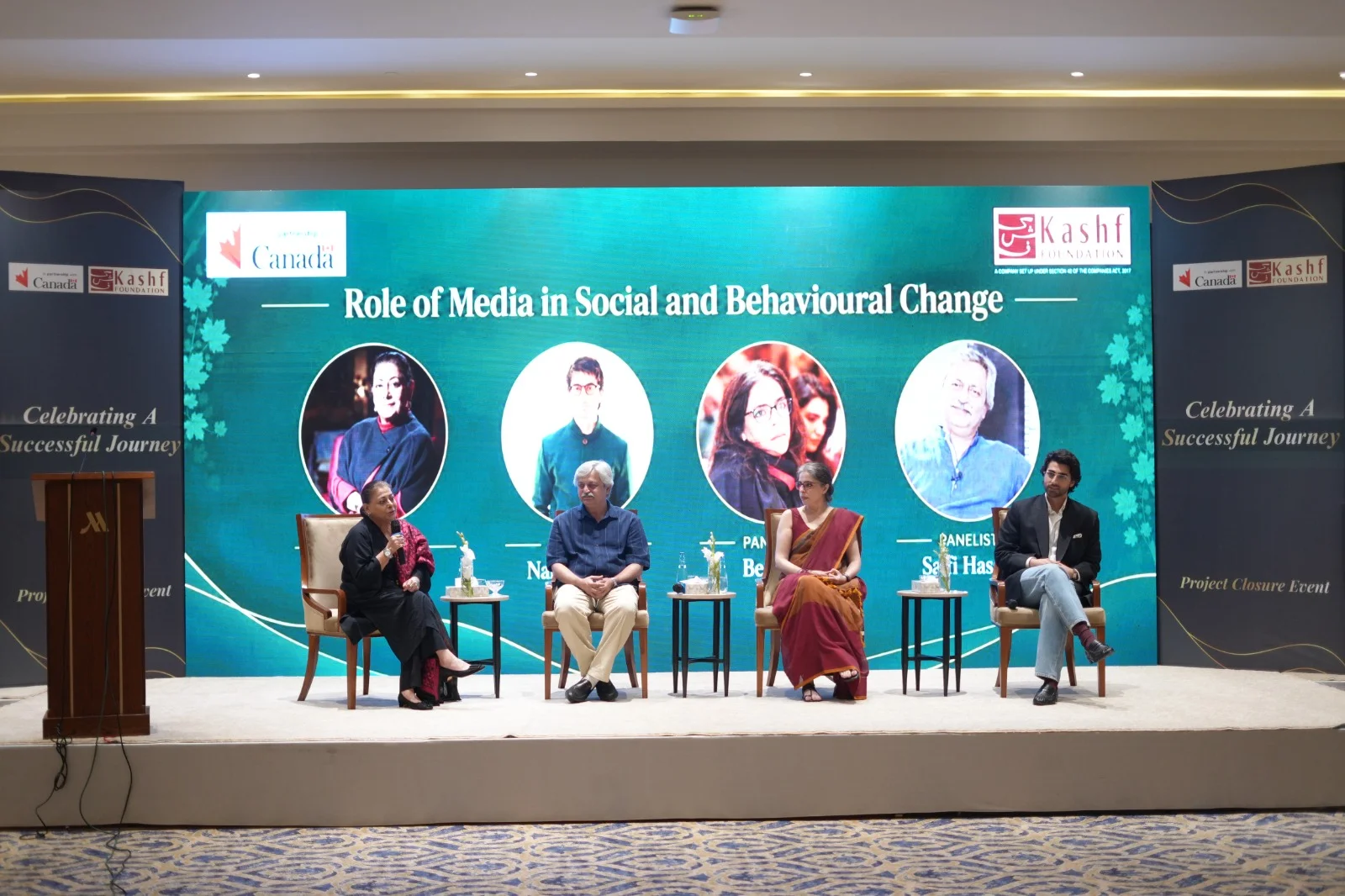
In much of Pakistan, the barriers that hold women back from economic life are not only financial. Expectations about what women should do, where they should go and who should make decisions at home can limit their opportunities long before the question of capital arises.
Over ten years of partnership, Kashf Foundation and Global Affairs Canada (GAC) have treated those expectations as part of the problem to be solved, working on social attitudes alongside access to finance.
The partnership has reached more than 1.6 million people across 63 districts in all four provinces, combining financial inclusion with health education, community engagement and media campaigns aimed at changing how families and communities view women’s work.
The Barriers Money Cannot Remove
The partnership’s starting point was that credit alone cannot clear the obstacles women micro-entrepreneurs face. Many of those obstacles are social and deeply rooted.
Kashf Foundation, which began in 1996 with five clients and now serves 1.2 million active clients across Pakistan, has long combined financial services with social advocacy for this reason.
Taking the Conversation Into Communities

Social theatre became one of the most direct ways to engage people on gender roles. Performances brought questions about women’s place at home and at work in front of community audiences.
The response was notable. Through social theatre, 88% of men reported a change in their views on gender roles.
Gender training was also offered to both men and women, and maternal and reproductive health training reached women, men and mothers-in-law, bringing family members into conversations that affect women’s well-being and choices.
Reaching Millions Through Television 
Television allowed the partnership to reach audiences on a national scale. Dramas on family planning, girls’ education and cybercrime carried these issues into homes across the country, each reaching an average of more than 120 million viewers.
Public service campaigns on television added to that reach, helping to bring these subjects into everyday conversation.
Where Attitudes and Finance Meet

Changing attitudes was never meant to replace financial support. In all, 1.4 million women received help ranging from basic financial literacy to structured financial education and business development training.
An independent third-party impact assessment, covering 2,596 households across 14 districts, shows how the two strands reinforced each other.
Some 94.5% of surveyed clients reported greater inclusion of women in household decision-making, and 83.4% said their families supported their businesses.
With that backing, training translated into income. Women who combined a microloan with financial management training increased their incomes by 17% more than untrained clients and saved 34% more, while those who completed business acceleration training earned 26% more than women with a loan alone.
After business acceleration training, more than one-third of participants decided where and how to save, and 33% were managing their businesses independently.
Reflections From the Partnership 
H.E. Tarik Ali Khan, High Commissioner of Canada to Pakistan, highlighted the role of social norms in the partnership’s approach.
“Kashf Foundation has always treated women’s economic empowerment as an entire household question. GAC is proud to have supported that approach and to have seen how economic opportunity, skills and changes in social norms can work together.”
Harriet Roos, Head of Cooperation at the High Commission of Canada, pointed to the importance of long-term investment.
“Lasting change for women takes sustained partnership. The evidence from this partnership shows the value of investing not only in women’s access to finance, but also in the skills, relationships and support systems that enable them to use those opportunities.”
“Ten years ago, with the support of Global Affairs Canada, we set out to prove that when women move forward, families prosper, communities strengthen and economies grow,” said Roshaneh Zafar, Founder and Managing Director of Kashf Foundation. “We’ve seen and made the impact. Now it’s time for policymakers and businesses to take these lessons to scale.”
Why Mindsets Matter for Growth
The partnership’s experience shows that attitudes change slowly, but they do change. When a husband rethinks his view of his wife’s work, or a family chooses to support her business, a loan becomes the beginning of something more durable.
For policymakers and businesses seeking to widen women’s economic participation, the lesson is clear: put resources in women’s hands, and give equal attention to the beliefs that determine whether they can use them.