

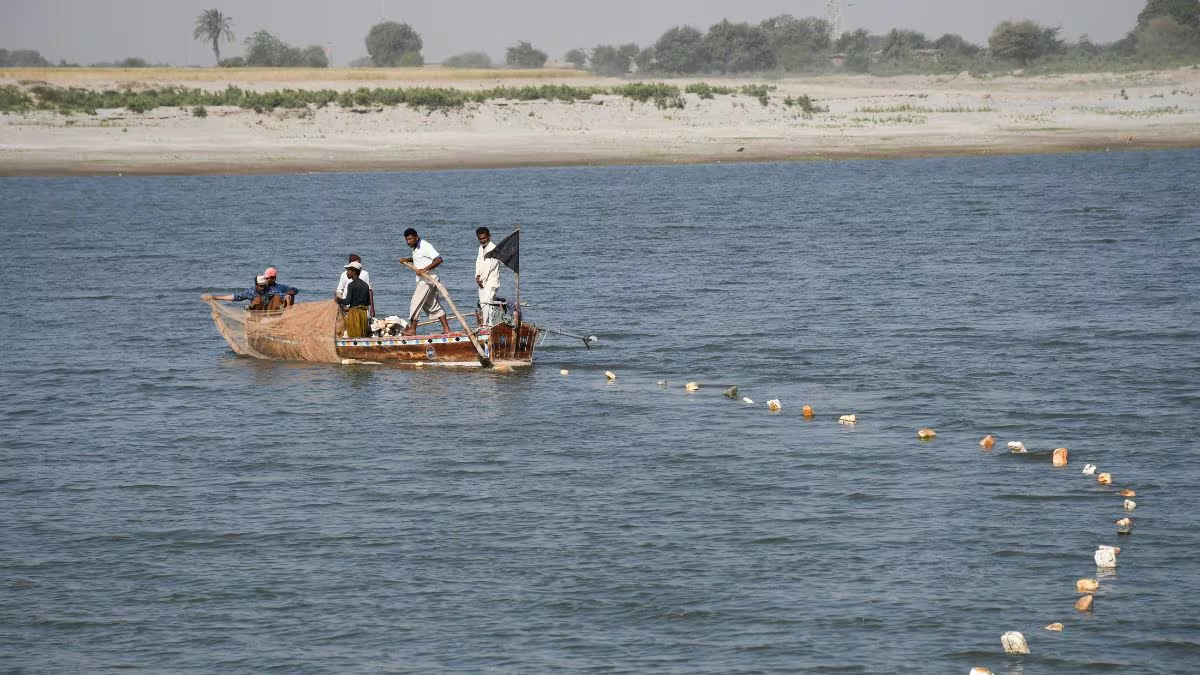
Under the ‘Pakistan Green Initiative’, canals are planned to be “Six Strategic Canals Project” including Thar and Raini Canals in Sindh, Cholistan and Greater Thal Canals in Punjab, Kachhi Canal in Balochistan, and Chashma Right Bank Canal in Khyber Pakhtunkhwa.
After the federal government’s announcement of a corporate farming project under the Green Pakistan Initiative, disputes between provinces over water distribution have resurfaced on Pakistan’s political scene.
These objections stem from the federal government’s announcement of a plan to build six canals to promote and ensure the success of corporate farming in the country.
Even the Pakistan People’s Party (PPP), a coalition partner of the ruling PML-N, is openly speaking out against the “Six Strategic Canals Project”.
The federal government has named this canal construction project the “Six Strategic Canals Project”.
It is worth noting that the strongest opposition to this canal project has come from Sindh, where farmers, nationalist and religious parties, opposition parties, and bar councils have been protesting for months.
A sit-in at Babarlo Bypass in Khairpur against the controversial canals has been ongoing for several days, blocking a key route between Sindh and Punjab.
The organizers of the sit-in have announced that if the “Six Strategic Canals Project” is not canceled by Thursday, they will also block railway tracks.
Gold, Precious Stones, and Minerals in Pakistan: What’s Hidden Underground and Why It’s Hard to Benefit From It
Meanwhile, Prime Minister Shahbaz Sharif’s advisor Rana Sanaullah has contacted nationalist leaders in Sindh and invited them to meet the Prime Minister.
On April 18, addressing a rally in Hyderabad, Pakistan People’s Party Chairman Bilawal Bhutto demanded that “the federal government must immediately withdraw this controversial project, or the PPP will not be able to continue supporting it, and this issue could endanger the federation.”
Bilawal Bhutto Zardari stated that the controversial “Six Strategic Canals Project” is an issue that could cause problems for Pakistan internationally.
Following this, the federal and Sindh governments agreed to resolve the water distribution and “Six Strategic Canals Project” issue through political understanding, but no significant progress has been made yet.+
However, moving beyond the political debate, we aim to understand what this six-canal project entails and why the most noise is being made about the Cholistan Canal and how it may affect Sindh’s share of water.
What is the federal government’s ‘Six Strategic Canals’ project?
The six-canal project was proposed as part of the Pakistan Green Initiative to develop the agriculture sector in the country.
Under this initiative, the federal government aims to bring 4 million acres of uncultivated land into cultivation. The government is acquiring this land from provinces, with the intent of promoting corporate farming, making the land cultivable, meeting national food needs, and benefiting farmers through modern farming techniques.
To irrigate the land under the Green Pakistan Initiative, new canals have been proposed in all four provinces:
- Thar and Raini Canals in Sindh
- Cholistan and Greater Thal Canals in Punjab
- Kachhi Canal in Balochistan
- Chashma Right Bank Canal in Khyber Pakhtunkhwa
The official approval for this canal project was given by the National Economic Council in February 2024 during the tenure of caretaker Prime Minister Anwaar-ul-Haq Kakar. However, this approval was conditional upon the endorsement of the Council of Common Interests (CCI), which has not yet held a meeting.
A key area in this project is Cholistan, which is being prepared for agriculture under the Green Initiative. This project involves building the Greater Thal Canal and upgrading the current Thal Canal, Jalalpur Canal, and Greater Cholistan Canal.
What do we know about these “Six Strategic Canals Project”?
During the National Assembly session in April, Federal Minister for Water Resources Moin Wattoo provided written information about six new canals.
According to official documents obtained by the BBC and details shared by the federal minister in the assembly:
- IRSA issued an NOC for the Lesser Cholistan Canal project for Punjab in January 2024.
- This project is being funded by the Punjab government and will draw water from the Sutlej River, aiming to irrigate the Cholistan region in Bahawalpur and Bahawalnagar districts.
- The total cost of the Cholistan project is Rs. 225.34 billion, and it has been forwarded by CDWP to ECNEC for approval.
Minister Moin Wattoo further stated in the assembly that:
- Sindh’s government submitted a request to cancel IRSA’s issued certificate on November 15, 2024, and a formal request for NOC for the Thar Canal project has not yet been submitted.
- WAPDA submitted a PC-1 of Rs. 212 billion for the Thar Canal project, which is currently unapproved.
- For the Greater Thal Canal, IRSA issued a water availability certificate in May 2008. Phase one, costing Rs. 10.17 billion, was completed in 2010 and handed over to Punjab.
- Phase two’s approval by ECNEC in 2024 was made conditional upon CCI approval.
He added:
- The Raini Canal project was approved by IRSA in 2002. Phase one was completed at a cost of Rs. 17.88 billion and handed over to Sindh.
- WAPDA completed the Raini Canal and handed it over to Sindh in January 2022. This canal is intended to irrigate 0.4 million acres in the Ghotki district and has a capacity of over 5,000 cusecs.
- IRSA granted the NOC for the Kachhi Canal project in Balochistan in October 2003. Phase one was completed in 2017. A PC-1 of Rs. 70 billion has been prepared for Phase two and is awaiting approval.
- For Chashma Right Bank Canal in Khyber Pakhtunkhwa, IRSA gave the NOC in April 2004, and ECNEC approved the Rs. 189.61 billion PC-1 in 2022. The project is currently in the award process.

Why is there a conflict between Sindh and the federation?
The controversy started on July 8 last year when a briefing on the canal project was given in a meeting chaired by President Asif Ali Zardari.
However, in March this year, during a joint session of Parliament, President Zardari stated that unilateral policies are putting the federation under pressure and that he cannot support the federal government’s decision to draw more canals from the Indus River.
According to water expert Naseer Memon, the government’s plan includes:
- Choubara Canal construction
- Kachhi Canal
- Raini Canal
- Thar Canal
- Chashma Right Bank Canal
- Cholistan Flood Feeder Canal
He noted that these canals would cover a total area of 3.58 million acres.
Naseer Memon added that for corporate farming in Greater Cholistan, the plan also includes three reservoirs on the Chenab River, two barrages on the Sutlej, and a feeder canal.
He pointed out that the Choubara Canal, which is a branch of the Greater Thal Canal, has faced opposition from Sindh from the very start. Though IRSA approved it in 2002, Sindh and federal members of IRSA opposed it. The Sindh Assembly passed two unanimous resolutions against it in 2003 and another in November 2021 to cancel it.
Despite opposition, ECNEC approved it on March 16, 2022. Now Sindh wants to raise this issue in the Council of Common Interests.
According to Naseer Memon, the Thar Canal will be derived from the Raini Canal. While there’s also opposition to the Jalalpur Canal, it is not part of the six disputed canals.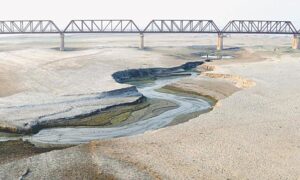
Expert and Political Opinions
Senator Rukhsana Zuberi from PPP told the BBC that this is a technical issue and her party is raising it from that perspective. She said the canals are already dry, and they are being told there’s no water from upstream.
She noted that 77% of Sindh’s agricultural land relies on canal irrigation, and most farmers are small landholders with an average of 12 acres.
Dr. Hassan Abbas stated that full details of the Cholistan Canal project are not being shared and that the project is much larger than reported potentially involving future canals, barrages, and dams. While the project appears to be Punjab’s, it will also affect Sindh.
He emphasized that any canal built on any river eventually impacts the Indus Basin.
IRSA spokesperson Khalid Rana told BBC that IRSA only checks if a province’s water rights are being affected, not the full project details. He added that Punjab assured IRSA that Sindh’s water share will not be used for the Cholistan Canal.
Dr. Shafqat Munir of SDPI said that five of the six canals are already completed, and the current dispute is mainly about the Cholistan Canal, which will draw water from the Sutlej River close to Marot and from Head Sulemanki.
He concluded, “This is more of a technical issue than a political one. Unless the political temperature cools down, progress will be difficult. And that will only happen when the Council of Common Interests convenes.”