
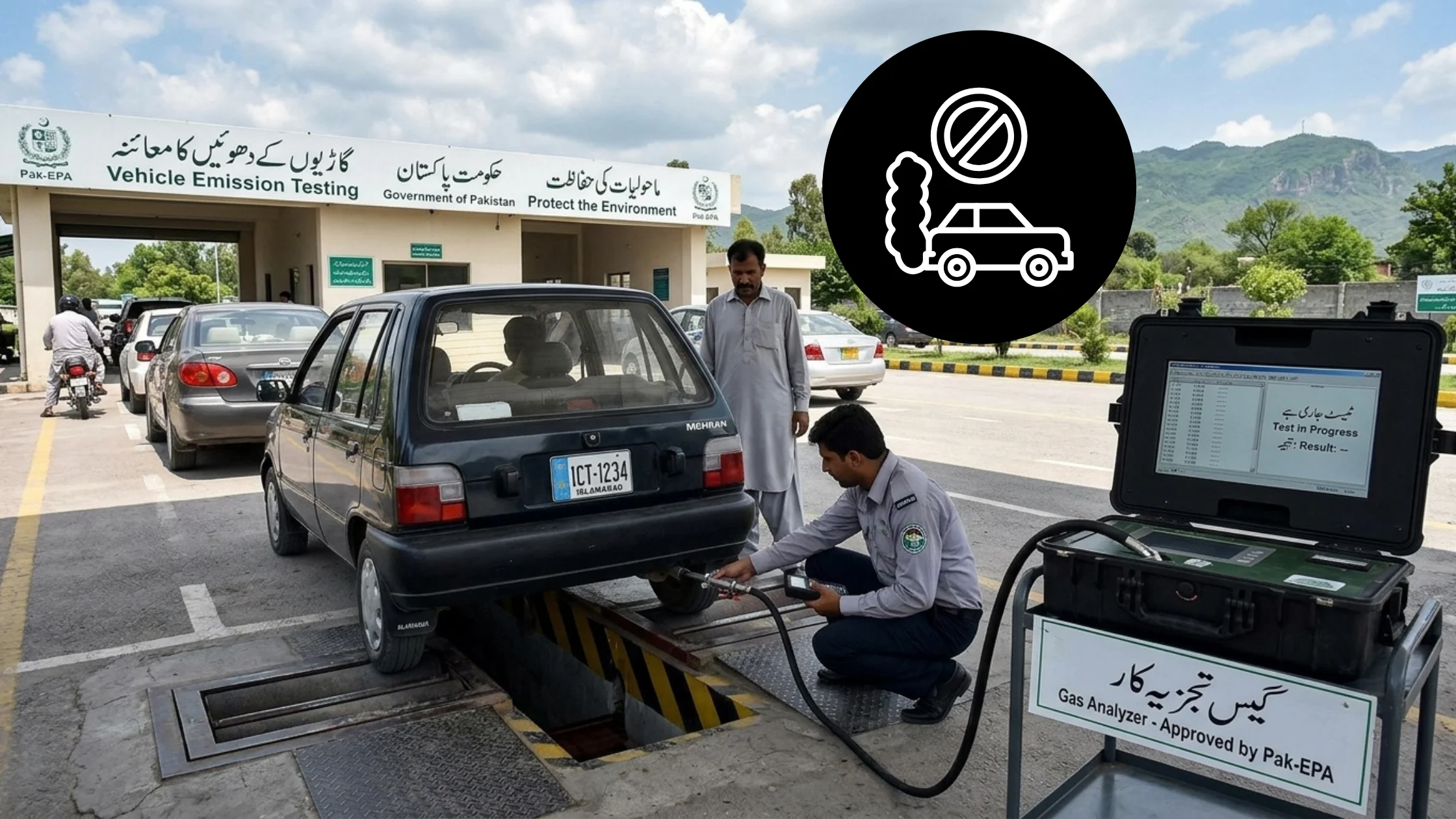
Islamabad may soon take a stricter approach to vehicle pollution as a National Assembly committee has recommended establishing a regular vehicle emission testing mechanism in the capital. The move is aimed at reducing air pollution and ensuring that vehicles operating in Islamabad meet environmental standards.
The recommendation came from the National Assembly Standing Committee on Climate Change and Environmental Coordination during its meeting on September 10, 2026. The committee reviewed the performance and enforcement capacity of the Pakistan Environmental Protection Agency (Pak-EPA) and raised concerns about the country’s environmental monitoring system.
The committee also recommended reviewing and updating the Pakistan Environmental Protection Act, 1997, saying environmental laws and regulations need to reflect current challenges and international environmental commitments.
Islamabad Could Introduce Regular Vehicle Emission Tests
One of the key recommendations was to move away from occasional roadside checks and establish a regular system for testing vehicle emissions.
Pak-EPA told the committee that it had inspected 50 diesel-engine commercial vehicles, with 11 vehicles fined for violating permissible emission limits. Committee members said such spot checks were not enough and that vehicles should undergo regular inspections.
The proposed system could eventually mean that vehicles operating in Islamabad would have to undergo emissions testing on a regular basis rather than only being checked during special enforcement drives.
However, the committee’s announcement is a recommendation, not yet confirmation that every private vehicle in Islamabad must immediately obtain an emissions certificate. Details such as testing frequency, fees, enforcement procedures and implementation dates would need to be finalized by the relevant authorities.
US Supreme Court Upholds Birthright Citizenship, Securing Automatic Citizenship for Newborns
MG JW Automobile Pakistan Signs MoU with RANCON to Export 5,000 Vehicles to Bangladesh by 2029!
New Auto Policy Sets Higher Export Targets for Pakistan’s Car Industry
Why Vehicle Emission Testing Matters
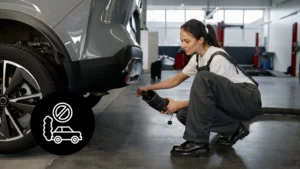
Vehicle exhaust is an important source of urban air pollution, particularly in cities with heavy traffic. Poorly maintained diesel engines can release excessive smoke and other pollutants, while older vehicles may be more likely to exceed permitted emission levels.
Regular testing can help authorities identify vehicles that need maintenance, engine tuning or other corrective measures.
Instead of waiting for visibly smoky vehicles to be caught on the road, a formal testing system could encourage owners to maintain their vehicles before they become a serious pollution problem.
Pakistan has already carried out several emission-monitoring operations in Islamabad. In one recent Pak-EPA operation, 50 heavy-duty diesel vehicles were tested for smoke opacity and 11 were found to be above permissible limits.
Pakistan Has Gone Years Without a National Environment Report
The parliamentary committee also expressed concern over the absence of a National Environment Report for almost a decade.
According to Pak-EPA, the last report was published in 2016. A new report covering the past five years is now being prepared in collaboration with the Sustainable Development Policy Institute (SDPI).
The agency informed the committee that the report is expected to be published by December 15, 2026.
The absence of updated national environmental data makes it harder to understand how pollution levels, water quality, waste management and other environmental indicators have changed over time.
A new report could provide policymakers with a clearer picture of Pakistan’s current environmental condition and help identify areas that need urgent action.
Pakistan’s Environmental Law May Also Be Updated
The committee recommended reviewing the Pakistan Environmental Protection Act, 1997, along with its related schedule.
The law provides the legal foundation for environmental regulation in Pakistan, but lawmakers now want it updated to address today’s environmental challenges and Pakistan’s international commitments.
Environmental problems have changed considerably since 1997. Urban air pollution, climate change, industrial emissions, plastic waste, traffic-related pollution and other environmental pressures have become increasingly important.
Updating the legal framework could also strengthen the ability of environmental authorities to enforce standards.
Pak-EPA Already Monitoring Vehicle Emissions
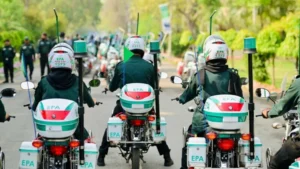
The proposed regular testing system would build on work that Pak-EPA has already been carrying out.
The agency has conducted several vehicle inspection drives in Islamabad with the Islamabad Traffic Police and other departments. These operations have focused particularly on diesel-powered commercial and heavy-duty vehicles.
During one monitoring exercise, Pak-EPA tested the smoke opacity of 50 heavy-duty diesel vehicles. Eleven were found to exceed permissible limits, and fines totaling Rs10,000 were imposed. The agency also said it had issued challans directly to violators under the relevant rules.
These operations show that vehicle emissions are already being monitored, but the parliamentary committee wants the process to become more regular and systematic.
Air Monitoring Systems Are Also Being Developed
Pak-EPA told the committee that it is working toward establishing air monitoring systems.
Air-quality monitoring is important because authorities need reliable data to understand pollution levels and identify pollution hotspots. But committee members emphasized that monitoring alone is not enough.
The chairperson urged the agency to focus more on prevention, rather than simply measuring pollution after it occurs.
This distinction could become important as Islamabad develops its broader air-quality strategy.
Electric Buses Could Help Reduce Transport Pollution
Another measure discussed during the committee meeting was the planned introduction of an electric bus system in Islamabad.
Pak-EPA said it was working with the Capital Development Authority (CDA) on the initiative.
Electric buses could help reduce emissions from public transport and provide residents with a cleaner alternative to private vehicles. Their environmental benefits, however, will depend partly on how the electricity used to charge them is generated and how effectively the public transport network is operated.
The committee’s broader approach suggests that reducing pollution will require more than simply testing vehicles.
Car-Pooling Could Also Be Encouraged
The committee also recommended encouraging car-pooling among officials through a social media campaign.
The idea is straightforward: fewer individual cars on the road can mean fewer vehicle emissions and less traffic congestion.
If adopted more widely, car-pooling could be part of a larger strategy that combines public transport, electric vehicles, walking, cycling and better traffic management.
The committee has therefore emphasized several approaches rather than relying on a single solution.
Pak-EPA Faces Funding and Staff Shortages
Implementing stronger environmental regulations could be difficult without sufficient resources.
During the meeting, Pak-EPA informed the committee that it faces shortages of funds and staff and is moving toward digitisation of its operations. The committee also sought information about employees serving on deputation and the reasons for their postings.
These issues matter because an emission-testing system would require testing equipment, trained staff, databases, inspection facilities and an enforcement mechanism.
Simply introducing a rule would not guarantee cleaner air. Authorities would need the capacity to inspect vehicles, record results, identify repeat violations and take action against vehicles that fail.
Pakistan’s Vehicle Emission Standards Also Need Attention
The issue of vehicle emissions is not new.
During a 2025 committee briefing, officials said Pakistan’s vehicle emission limits remained at Euro-II levels, while modern standards in many countries have moved toward Euro-V and Euro-VI benchmarks. The committee had previously called for a comprehensive and time-bound plan to improve air quality.
This shows that the current push for regular testing is part of a wider discussion about improving Pakistan’s vehicle emission regulations.
Stricter standards, however, would also need to consider the condition of Pakistan’s vehicle fleet, fuel quality, inspection capacity and the financial impact on vehicle owners.
What Could Mandatory Testing Mean for Vehicle Owners?
If a regular testing system is introduced, vehicle owners could eventually face additional responsibilities.
They may need to take their vehicles to authorized testing centers and ensure that engines and exhaust systems remain within permitted limits. Vehicles that fail could potentially require maintenance or repairs before being allowed to continue operating.
The exact procedure has not yet been announced, so it would be premature to assume that every vehicle owner will immediately face a new testing fee or penalty.
The important development at this stage is that the parliamentary committee has formally recommended a regular mechanism rather than relying on occasional spot checks.
Islamabad Could Become a Model for Other Cities
Islamabad’s relatively controlled urban environment could provide an opportunity to test a stronger vehicle-emission enforcement model.
If regular testing works effectively in the capital, similar systems could potentially be considered in other major cities such as Lahore, Karachi, Rawalpindi, Peshawar and Faisalabad.
Air pollution is not limited to Islamabad. Major Pakistani cities regularly face problems involving traffic emissions, industrial pollution, construction dust and other sources.
A successful system could therefore provide experience for a broader national clean-air strategy.
Cleaner Air Will Require More Than Vehicle Testing
Vehicle testing alone cannot solve Pakistan’s air-pollution problem.
Traffic emissions are only one part of the picture. Industrial pollution, construction dust, waste burning, fuel quality and other sources also contribute to poor air quality.
That is why the committee has discussed air monitoring, electric buses, car-pooling, stronger enforcement and updated environmental laws alongside vehicle testing.
A successful clean-air strategy will need coordination between Pak-EPA, traffic authorities, CDA, transport agencies and other government departments.
Stronger Enforcement Could Be the Biggest Challenge
Pakistan already has environmental standards and laws. The bigger question is how consistently they are enforced.
Past inspection drives have shown that some vehicles exceed permitted emission limits. The challenge is turning these occasional operations into a reliable system that works throughout the year.
That would require adequate funding, trained personnel, modern equipment and digital records.
The government would also need to make sure the system is transparent so that vehicle owners understand the standards and testing process.
What Happens Next?
For now, the mandatory regular testing system is a parliamentary committee recommendation, rather than a fully implemented nationwide rule.
The next steps would likely involve the relevant government agencies working out the practical details of how regular emission testing could operate in Islamabad.
At the same time, the committee has called for the environmental law to be reviewed and for stronger institutional capacity.
The upcoming National Environment Report, expected by December 15, 2026, could also provide important information for future environmental policies.
Islamabad’s Clean-Air Push Is Gaining Momentum
The latest recommendation represents a stronger push toward controlling vehicle pollution in Islamabad.
The message from the parliamentary committee is clear: occasional spot checks are not enough. If vehicle emissions are to be controlled effectively, testing needs to become regular, enforcement needs to be stronger and environmental institutions need adequate resources.
The proposed approach combines vehicle testing with air monitoring, electric public transport, car-pooling and legal reforms.
Whether these recommendations translate into effective action will depend on implementation. But if Islamabad can establish a transparent and properly resourced emission-testing system, it could become an important model for other Pakistani cities facing growing air-pollution problems.
Frequently Asked Questions
1. Is vehicle emission testing becoming mandatory in Islamabad?
The National Assembly Standing Committee on Climate Change and Environmental Coordination has recommended a regular vehicle emission testing mechanism for Islamabad. The recommendation still needs to be translated into an operational system with specific rules and procedures.
2. How many vehicles were recently fined for emissions violations?
Pak-EPA told the committee that 50 diesel-engine commercial vehicles were inspected and 11 were fined for violations.
3. When was Pakistan’s last National Environment Report published?
The last National Environment Report was published in 2016. Pak-EPA told the committee that a new report is being prepared and is expected by December 15, 2026.
4. Will every vehicle owner in Islamabad have to pay for an emissions test?
No fee or testing procedure for all vehicles has been officially announced yet. The committee has recommended establishing a regular mechanism, but the implementation details still need to be finalized.
5. Will Pakistan’s environmental law be updated?
The committee has recommended reviewing and updating the Pakistan Environmental Protection Act, 1997, including its schedule, to address current environmental challenges and international environmental commitments.