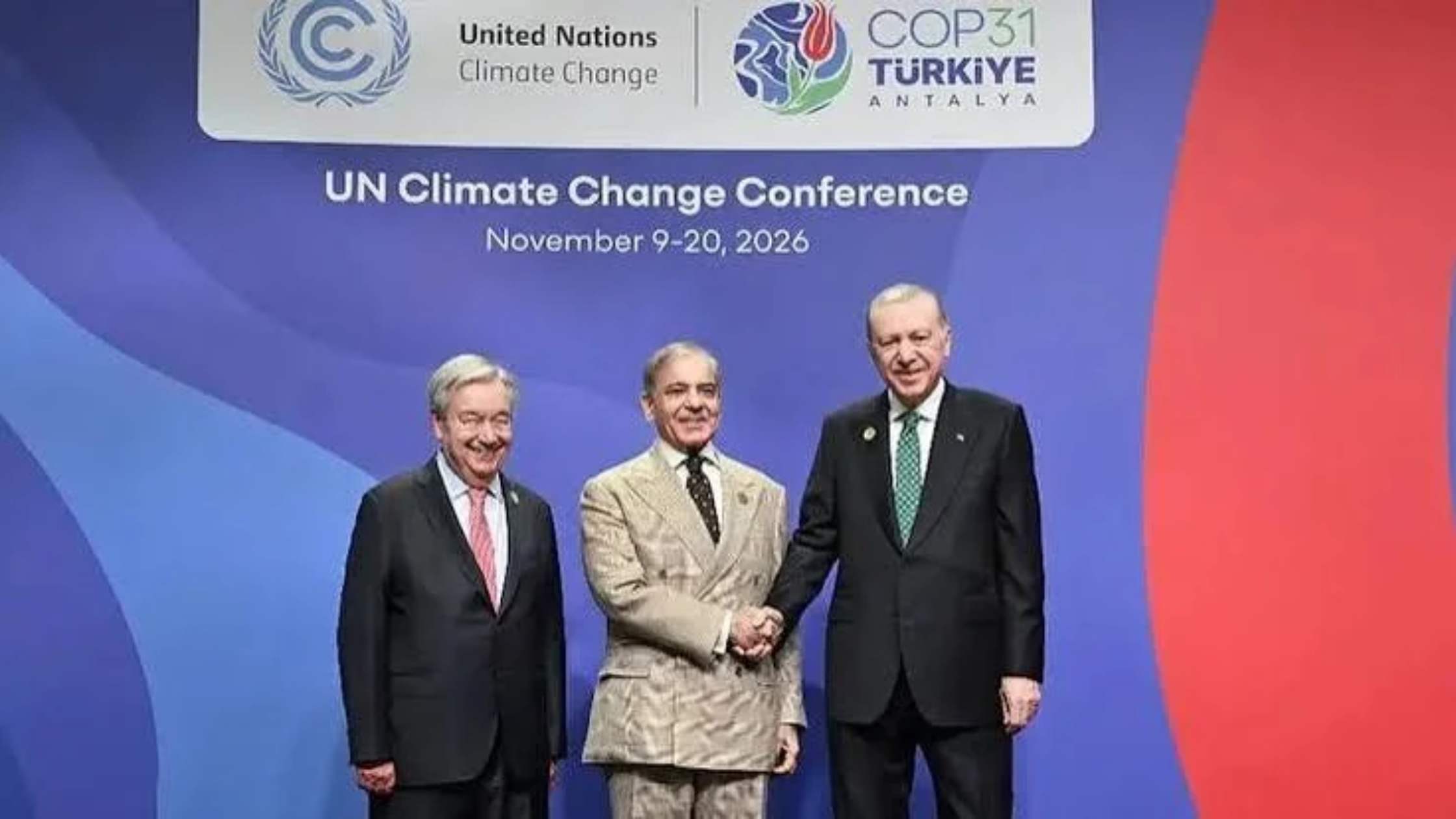
Prime Minister Shehbaz Sharif has highlighted Pakistan’s rapid transition towards solar energy and clean power during his visit to Türkiye for the 31st United Nations Climate Change Conference (COP31). Addressing world leaders in Antalya, the prime minister said Pakistan had added nearly 22,000 megawatts of rooftop solar capacity in just two years, describing the development as a major shift towards affordable and cleaner electricity.
During his address at the high-level dialogue titled “35 by 35: Powering the Future,” Shehbaz reaffirmed Pakistan’s support for the global electrification target, which aims to increase electricity’s share of total final energy consumption to around 35% by 2035.
The prime minister also called for stronger international cooperation, affordable technology, and climate financing to help developing countries move towards cleaner energy without increasing their financial difficulties.
PM Shehbaz Sharif Arrives in Antalya for COP31 Summit

Prime Minister Shehbaz Sharif arrived in Antalya, Türkiye, on an official visit to participate in the COP31 Leaders’ Summit.
He was received by Turkish Deputy Minister of Culture and Tourism Gökhan Yazgı, Pakistan’s Ambassador-designate to Türkiye Amna Baloch, and senior Turkish officials.
During the summit, the prime minister is scheduled to highlight Pakistan’s climate priorities, including renewable energy expansion, disaster preparedness, climate resilience, and the need for stronger global action against climate change.
He is also expected to discuss cooperation with Turkish President Recep Tayyip Erdoğan and other international leaders attending the conference.
Pakistan Adds Nearly 22,000 MW of Rooftop Solar Capacity
One of the key points in Shehbaz Sharif’s address was Pakistan’s rapid expansion of rooftop solar energy.
The prime minister said the country had added nearly 22,000 megawatts (22 gigawatts) of rooftop solar capacity within two years. He described the development as a major transformation driven by households and businesses seeking affordable electricity and a more predictable energy supply.
Pakistan’s growing solar adoption reflects increasing interest in alternative energy sources amid electricity costs and concerns about dependence on conventional power generation.
Shehbaz said the country was moving towards a cleaner energy future and reaffirmed its commitment to expanding renewable energy capacity.
Pakistan Rolls Over $3 Billion Saudi Loan, Says Finance Minister Muhammad Aurangzeb
How Can Pakistanis Get Jobs in Germany? Government Issues Application Guidelines
PCRWR Declares 27 Bottled Water Brands Unsafe for Drinking in Pakistan
Pakistan Supports the 35-by-35 Global Electrification Pledge

During the high-level dialogue, the prime minister expressed Pakistan’s support for the 35-by-35 Global Electrification Pledge.
The initiative aims to increase electricity’s share of total final energy consumption to approximately 35% by 2035.
The target focuses on expanding the use of electricity across different sectors, including transportation, buildings, and industrial activities. Electrification can help reduce emissions, particularly when electricity is generated through renewable and other low-carbon sources.
Shehbaz stressed that achieving this target would require stronger electricity networks, reliable energy storage systems, and affordable technologies.
He also thanked Turkish President Recep Tayyip Erdoğan for organising the dialogue under Türkiye’s COP31 presidency.
Pakistan’s Clean Energy Mix Reaches Nearly 55%

The prime minister also highlighted Pakistan’s progress in expanding cleaner energy sources.
According to his address, clean sources now account for nearly 55% of Pakistan’s energy mix. He also referred to progress on the Chashma Nuclear Power Plant-5 project, saying it would add approximately 1,200 MW of electricity to the national grid.
Nuclear power is considered a low-carbon source of electricity because it generates power without the direct carbon emissions associated with burning fossil fuels.
The government is also focusing on renewable energy expansion and improvements in the country’s overall electricity system.
Pakistan Plans to Expand Electric Vehicles
Another important part of the prime minister’s speech focused on the transition towards electric vehicles.
Shehbaz said Pakistan’s newly drafted automobile policy includes incentives through lower tariffs to encourage electric vehicle adoption.
He also stated that the government aims to make all future government buses and motorcycles electric.
According to the prime minister, more than one in every ten motorcycles sold in Pakistan this year was electric for the first time.
The shift towards electric mobility could help reduce fuel consumption, lower transport-related emissions, and support the development of a local electric vehicle industry.
However, expanding electric vehicles will also require investment in charging stations, electricity distribution networks, battery technology, and affordable financing.
Pakistan Needs $188 Billion for Its Clean Energy Transition
Despite progress in solar energy and other clean power sources, Shehbaz Sharif warned that Pakistan’s transition would require substantial financial support.
The prime minister estimated that Pakistan would need approximately $138 billion by 2035 for low-carbon power generation.
He added that another $50 billion would be required to replace coal-based energy with solar power.
Together, these estimates represent around $188 billion in financing needs for the country’s clean energy ambitions.
Shehbaz said that expanding electricity grids, improving energy storage, and making modern technologies affordable were essential for achieving long-term climate goals.
He also stressed that developing countries should not be forced to increase their debt burdens while trying to address climate change.
“Finance must flow at the speed of ambition,” the prime minister said, calling for concessional financing and technology transfers from developed countries.
PM Shehbaz Meets Iranian President and Other World Leaders
On the sidelines of COP31, Prime Minister Shehbaz Sharif held meetings and informal discussions with several international leaders.
He met Iranian President Masoud Pezeshkian and his delegation to discuss bilateral relations, economic cooperation, and regional developments.
According to the Prime Minister’s Office, the discussions also covered regional peace and stability. Shehbaz emphasised dialogue, restraint, de-escalation, and sustained diplomacy as important steps towards lasting peace.
The prime minister also met Kuwait’s Prime Minister Ahmad Al-Abdullah Al-Ahmad Al-Sabah. Both leaders discussed strengthening cooperation in trade, investment, energy, development, and people-to-people exchanges.
Other interactions included meetings with Bangladesh’s Prime Minister Tarique Rahman, Palestinian Prime Minister Mohammad Mustafa, Syrian President Ahmed al-Sharaa, and Saudi officials.
Shehbaz also met World Bank President Ajay Banga, Organisation of Islamic Cooperation chief Ismail Ould Cheikh Ahmed, and Türkiye’s First Lady Emine Erdoğan.
During his interaction with the Palestinian prime minister, Shehbaz reaffirmed Pakistan’s solidarity with the Palestinian people.
Pakistan Pavilion Hosts 54 Events at COP31
Pakistan has established a dedicated pavilion at the COP31 venue to showcase its climate priorities, projects, and initiatives.
According to the government, the pavilion will host 54 events covering different climate-related themes.
These activities are intended to highlight Pakistan’s efforts in renewable energy, climate adaptation, disaster preparedness, and international climate cooperation.
Pakistan has also played an active role in previous climate negotiations. Its climate diplomacy contributed to efforts that led to the establishment of the Loss and Damage Fund at COP27, designed to support countries suffering the consequences of climate-related disasters.
COP31 Focuses on Global Climate Action and Clean Energy
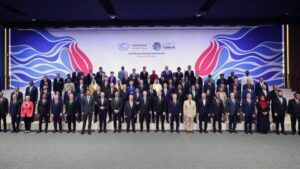
COP31 is bringing together representatives from nearly 200 countries in Antalya to discuss climate change, energy transition, and international cooperation.
The summit comes at a time when extreme weather events, rising temperatures, and geopolitical tensions are creating additional challenges for governments.
United Nations Secretary-General António Guterres warned world leaders that the climate crisis was advancing faster than international efforts to address it. He called for stronger action to reduce emissions and accelerate the transition towards clean energy.
Türkiye’s presidency has placed the 35-by-35 electrification target among the key discussions at the summit. However, questions remain about how countries will generate the additional electricity and ensure that the expansion genuinely reduces dependence on fossil fuels.
Developing countries are also seeking more predictable climate financing to support adaptation, renewable energy projects, and protection against climate-related disasters.
Conclusion
Prime Minister Shehbaz Sharif’s address at COP31 has brought international attention to Pakistan’s growing solar energy capacity and its plans for a cleaner energy future.
His announcement of nearly 22,000 MW of rooftop solar capacity added within two years highlights the growing role of alternative energy in Pakistan. The government is also focusing on electric mobility, nuclear power, renewable energy expansion, and stronger climate resilience.
However, the prime minister made clear that achieving these ambitions will require substantial financial resources, affordable technology, and international cooperation.
For Pakistan, the challenge is to turn its growing clean energy momentum into a sustainable and reliable energy system while protecting the country from the increasing effects of climate change.