

Pakistan has reaffirmed its commitment to the Makkah Defence Agreement with Saudi Arabia and Türkiye, as the three countries move toward putting the new defence framework into practice.
The agreement was signed in Makkah on August 7, 2026, and provides that an armed attack against any one of the three countries will be regarded as an attack against all three. Pakistan has repeatedly described the pact as defensive in nature and said it is intended to strengthen collective deterrence, regional security and cooperation rather than target any particular country.
The latest developments show that the agreement is moving beyond its initial political announcement. Pakistan, Saudi Arabia and Türkiye have established institutional mechanisms, appointed a secretary general and held meetings between senior military officials to discuss how the commitments can be translated into practical defence cooperation.
What Is the Makkah Joint Defence Agreement?
The Makkah Joint Defence Agreement, also referred to as the Makkah Accord, is a trilateral defence framework involving Pakistan, Saudi Arabia and Türkiye.
The agreement seeks to formalise and strengthen existing defence relationships between the three countries. According to Pakistan’s Foreign Office, cooperation under the framework includes training, capacity-building, sharing best practices, defence technology and research, and collective deterrence against threats to regional security.
The agreement’s most important provision is its collective-defence commitment.
Under the pact, an armed attack against one member is to be considered an attack against all three members. Pakistan’s Foreign Office has linked this provision to the right of individual and collective self-defence recognised under Article 51 of the United Nations Charter.
This does not mean that every regional security incident automatically results in military action by all three countries. The specific response would depend on the circumstances, the nature of an attack and decisions taken through the agreement’s mechanisms.
Pakistan Says the Pact Is Defensive
Pakistan has repeatedly emphasised that the agreement is defensive rather than offensive.
In a September 17 Foreign Office briefing, spokesperson Sajjad Haider Khan said the agreement was aimed at strengthening regional peace and stability and enhancing defence cooperation between the three countries.
He also said the agreement was not directed against any country and did not formally constitute a new bloc.
Pakistan’s position was also stated when the agreement was originally signed. Deputy Prime Minister and Foreign Minister Ishaq Dar described the pact as defensive and said its purpose was to strengthen collective deterrence and the ability of the three countries to defend their sovereignty and territorial integrity.
This distinction has become particularly important because the agreement was signed during a period of heightened tensions across the Middle East.
Saudi-Pakistan-Turkey Pact Signals a Shift in Gulf Security Order: US Think Tank
Attack on One Member Considered an Attack on All
The collective-defence provision is the central feature of the Makkah agreement.
It means that if one member suffers an armed attack, the incident becomes a matter of collective concern for Pakistan, Saudi Arabia and Türkiye.
The wording has drawn comparisons with collective-defence arrangements such as NATO’s Article 5, although the Makkah agreement has its own structure and does not simply replicate NATO’s institutional model.
The three countries have said their objective is collective deterrence and defence while supporting regional peace and de-escalation.
The agreement does not publicly establish a single automatic military response for every possible scenario. Instead, the countries are developing mechanisms for cooperation and coordination.
Agreement Moves Toward Practical Implementation
Since the agreement was signed, the three countries have taken steps to create an institutional structure.
On August 31, the inaugural meeting of the Strategic Political and Defence Committee was held in Istanbul. The participating countries agreed to further institutionalise cooperation and strengthen collective deterrence and defence.
The countries also agreed to establish a Secretariat in Saudi Arabia.
Pakistan was given responsibility for providing the secretary general during the initial three-year period. Pakistan subsequently appointed retired Lieutenant General Nauman Mahmood as the first secretary general of the Makkah Defence Alliance.
The creation of the secretariat provides the agreement with a permanent institutional mechanism for coordinating future activities.
Military Chiefs Meet in Riyadh
The agreement has also moved into a more detailed military-cooperation phase.
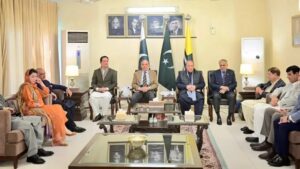
On September 25, the military chiefs of Pakistan, Saudi Arabia and Türkiye met in Riyadh to discuss ways to strengthen cooperation under the Makkah framework.
The meeting focused on areas including intelligence sharing, military coordination and capability integration.
The three military chiefs also expressed a determination to translate the commitments made under the agreement into practical military cooperation.
This development is important because it indicates that the pact is not limited to political statements or diplomatic meetings.
At the same time, the details of any potential deployments or specific military operations have not been publicly disclosed.
Pakistan Has Not Announced Specific Troop Deployments
Questions have been raised about what Pakistan’s collective-defence commitment would mean if one of the member states faced a major attack.
Pakistan’s Foreign Office has avoided publicly discussing operational details.
During a September 17 briefing, the Foreign Office spokesperson was asked specifically whether an invasion or troops on the ground would make the agreement operational. The spokesperson said the agreement’s implementation mechanisms were still being developed and described operational matters as confidential.
Therefore, it would be inaccurate to assume that the agreement automatically means a predetermined number of Pakistani troops would be deployed in any future conflict.
The actual response would depend on the circumstances and decisions made by the participating governments and military authorities.
Three Countries Discuss Assistance to Saudi Arabia
The question of practical assistance has become more relevant following attacks targeting Saudi Arabia during the current regional tensions.
On September 25, the foreign ministers of Pakistan, Saudi Arabia and Türkiye met on the sidelines of the United Nations General Assembly in New York.
According to Pakistan’s Foreign Office, they discussed plans to convene an urgent meeting of the three countries’ chiefs of staff to explore ways to assist Saudi Arabia under the Makkah Joint Defence Agreement.
The ministers also reaffirmed the agreement’s collective-defence provision and discussed regional security, freedom of navigation and the need for de-escalation.
The following day, the military chiefs met in Riyadh.
This sequence of meetings shows that the three countries are working on mechanisms for responding to security challenges, although the exact operational arrangements remain undisclosed.
Regional Tensions Add Importance to the Agreement
The Makkah pact comes at a time of continuing security concerns in the Middle East.
Recent attacks involving Yemen’s Houthi movement have affected Saudi territory and infrastructure, adding urgency to discussions about regional defence cooperation. Reuters reported that Turkish officials have expressed readiness to help Saudi Arabia with military and technical requirements under the agreement.
Pakistan has maintained that the Makkah agreement should not be viewed as an instrument for confrontation.
Its Foreign Office has repeatedly linked the framework with regional peace, stability, restraint and peaceful resolution of crises.
This combination of deterrence and diplomacy is central to how Islamabad has publicly presented the agreement.
Defence Cooperation Goes Beyond Military Exercises
The Makkah agreement is broader than simply conducting joint military exercises.
According to Pakistan’s Foreign Office, the framework includes:
- Defence training and capacity-building
- Exchange of military best practices
- Defence technology and research cooperation
- Joint activities
- Defence-industry cooperation
- Joint technology development and production
- Collective deterrence
- Greater coordination between the armed forces
The Strategic Political and Defence Committee has specifically agreed to strengthen defence capabilities through defence-industry cooperation and joint technology development and production.
This could eventually create opportunities for cooperation in areas such as military technology, research and defence manufacturing.
However, the exact projects and timelines will depend on future decisions by the three countries.
Pakistan, Saudi Arabia and Türkiye Have Long Defence Ties
The Makkah agreement did not create defence relations between the three countries from scratch.
Pakistan already has longstanding defence and military relationships with both Saudi Arabia and Türkiye.
The Foreign Office has described the agreement as a way to formalise and strengthen many areas of existing cooperation.
Pakistan and Saudi Arabia have maintained defence cooperation for decades, including military training and other forms of security collaboration.
Pakistan and Türkiye also have extensive military ties, including cooperation in defence technology and training.
The new agreement creates a trilateral structure through which some of these relationships can be coordinated more closely.
Could Other Countries Join the Agreement?
There has also been discussion about whether the Makkah defence framework could eventually expand beyond its three founding members.
Pakistan’s Foreign Office has said that the agreement could potentially be open to countries that share similar security interests and are willing to accept its collective obligations.
However, Islamabad has also made clear that the immediate priority is to consolidate cooperation among Pakistan, Saudi Arabia and Türkiye.
Türkiye’s parliamentary leadership has separately discussed the possibility of a wider Muslim-world security framework.
For now, however, the formal agreement remains a three-country arrangement.
What Does the Agreement Mean for Pakistan?
For Pakistan, the pact provides a formal framework for closer security cooperation with two strategically important partners.
It also gives Islamabad an additional channel for discussing regional security issues with Saudi Arabia and Türkiye.
The agreement could create opportunities for cooperation in defence technology, military training, intelligence coordination and defence production.
At the same time, the pact creates commitments that could become relevant if any member faces an armed attack.
The precise scope of those commitments will depend on the agreement’s implementation mechanisms and decisions taken during an actual crisis.
What Does It Mean for Saudi Arabia?
For Saudi Arabia, the agreement provides a formal collective-defence framework with two countries that have established military capabilities and longstanding relations with the Kingdom.
The recent meetings have focused particularly on strengthening cooperation in response to security threats affecting Saudi Arabia.
Türkiye has publicly discussed providing military and technical assistance under the pact, while Pakistan has reaffirmed its commitment to the agreement and participated in the recent military-level consultations.
The agreement therefore gives Saudi Arabia another framework for defence coordination alongside its existing bilateral relationships.
What Does It Mean for Türkiye?
For Türkiye, the agreement creates another mechanism for defence cooperation with Pakistan and Saudi Arabia.
Türkiye has also emphasised that the pact does not seek to replace its existing alliances or target a specific country.
The country has indicated that it could provide military and technical support to Saudi Arabia under the agreement if required.
Türkiye’s role is also significant because it has a large defence industry and extensive experience in developing and exporting military technology.
The Agreement and Regional De-Escalation
One of the notable aspects of the agreement is that its official statements combine collective defence with calls for de-escalation.
The Strategic Political and Defence Committee said the three countries would continue supporting restraint and peaceful resolution of crises while strengthening collective deterrence.
This means the three governments are presenting defence cooperation and diplomatic engagement as complementary rather than mutually exclusive.
The agreement’s public messaging therefore focuses on preventing attacks through deterrence while continuing to support diplomatic efforts to reduce regional tensions.
What Remains Unclear?
Despite the progress made since August, several details remain undisclosed.
The governments have not publicly outlined a fixed military response for every possible type of attack.
There is also no publicly announced formula specifying the number of troops, aircraft, ships or other military assets that would automatically be committed in a particular situation.
Operational decisions would depend on the nature of the threat and consultations between the member states.
The recent military chiefs’ meeting is intended to develop greater practical coordination, but its public statements did not provide detailed operational plans.
A New Phase for the Makkah Agreement
The Makkah Joint Defence Agreement has moved quickly from its signing in August to the creation of an institutional structure and high-level military coordination in September.
Pakistan continues to describe the agreement as defensive and focused on collective deterrence, while Saudi Arabia and Türkiye have also been involved in developing mechanisms for practical cooperation.
The establishment of a secretariat in Saudi Arabia, the appointment of Pakistan’s first secretary general and meetings among the three countries’ military chiefs all indicate that the framework is being developed beyond the initial signing ceremony.
At the same time, the three countries continue to emphasise regional peace, de-escalation and peaceful resolution of disputes.
The most significant unanswered question remains how the collective-defence commitment would be applied in a specific crisis. For now, the governments have kept those operational details confidential while continuing discussions through diplomatic and military channels.
FAQs
1. What is the Makkah Joint Defence Agreement?
The Makkah Joint Defence Agreement is a defence framework signed by Pakistan, Saudi Arabia and Türkiye on August 7, 2026. It provides that an armed attack against one member will be regarded as an attack against all three.
2. Is the Makkah agreement directed against a particular country?
Pakistan’s Foreign Office has said the agreement is defensive in nature and not directed against any country. Officials have described its purpose as strengthening collective deterrence, defence and regional stability.
3. Does the agreement automatically mean Pakistan will send troops if Saudi Arabia is attacked?
The agreement establishes a collective-defence commitment, but Pakistan has not publicly announced a fixed number of troops or a predetermined deployment plan for every possible scenario. Operational details remain subject to consultations and security considerations.
4. Have the military chiefs of the three countries met?
Yes. The military chiefs of Pakistan, Saudi Arabia and Türkiye met in Riyadh on September 25, 2026, where they discussed intelligence sharing, military coordination and capability integration under the agreement.
5. Could other countries eventually join the Makkah agreement?
Pakistan has said the framework could potentially be open to countries that share its security interests and accept its collective obligations. However, the immediate focus remains on strengthening cooperation among the three founding members.