

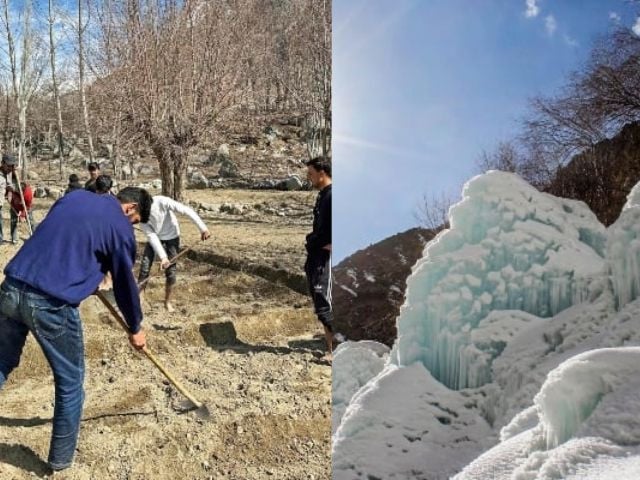
Amidst the breathtaking, snow-kissed peaks of northern Pakistan, where nature’s grandeur meets the harsh realities of climate change, a group of resilient farmers in Gilgit-Baltistan is turning to innovation to solve a growing crisis — water scarcity.
Rising temperatures and shorter winters have led to reduced snowfall, cutting off the natural supply of meltwater that traditionally nourished the valleys each spring. In response, farmers in the high-altitude Skardu Valley, sitting 2,600 meters above sea level in the shadow of the mighty Karakoram range, found an unlikely solution: artificial glaciers.
Desperate for alternatives to keep their apple and apricot orchards alive, locals turned to the internet and discovered the concept of “ice stupas” — cone-shaped ice structures that slowly release water as they melt during the warmer months. The technique was pioneered by Indian engineer and climate activist Sonam Wangchuk in Ladakh, not far from the region, and has since inspired communities across the border.
“We saw videos online and decided to give it a try,” shared Ghulam Haider Hashmi, one of the early adopters of the method.
Using pipes to channel water from mountain streams, the farmers spray it into the freezing winter air. As the water droplets crystallize, they form vertical towers of ice — resembling Buddhist stupas — that serve as natural reservoirs. These ice formations begin to melt gradually in the spring, offering a much-needed source of water during the planting season.
According to Professor Zakir Hussain Zakir from the University of Baltistan, the key is to spray water in sub-zero temperatures so it freezes mid-air, forming tall ice cones that act as a slow-release water bank.
Though Gilgit-Baltistan boasts over 13,000 glaciers — the highest concentration outside the polar regions — warming temperatures and shifting snowfall patterns have begun to threaten their stability. Sher Muhammad, a glacier expert at ICIMOD, explained that the bulk of the region’s water comes from snowmelt, not glacial runoff, making it even more vulnerable to warmer, drier winters.
The first ice stupas in the region were constructed in 2018. Since then, more than 20 villages have adopted the approach, benefiting over 16,000 people who now have access to reliable irrigation without building costly water tanks or reservoirs.
In the village of Hussainabad alone, eight ice stupas were created this winter, trapping an estimated 20 million liters of water, says Rashid-ud-Din, provincial head of GLOF-2 — a UN-backed climate adaptation project.
“We used to struggle for water until June,” shared Ali Kazim, a farmer. “Now, our fields are irrigated by the stupas, and planting starts much earlier.”
The impact has been transformational. Bashir Ahmed, a young farmer in Pari village, explained, “Previously, we had to delay planting until May and managed only one crop cycle. Now, we can grow two or even three times a year.”
Pakistan, already one of the most climate-vulnerable nations, has seen temperatures rise at nearly twice the global rate. With 80% of the country classified as arid or semi-arid, and more than three-quarters of its water supply depending on rivers originating from neighboring countries, innovative local solutions like these artificial glaciers are not just smart — they’re essential.
As glaciers recede and weather patterns grow more erratic, the humble yet powerful ice stupa stands as a symbol of resilience and ingenuity in the face of a global crisis.
“In the battle against climate change, we’re all in this together,” said 24-year-old Yasir Parvi. “These ice stupas are our way of fighting back — one frozen drop at a time.”