
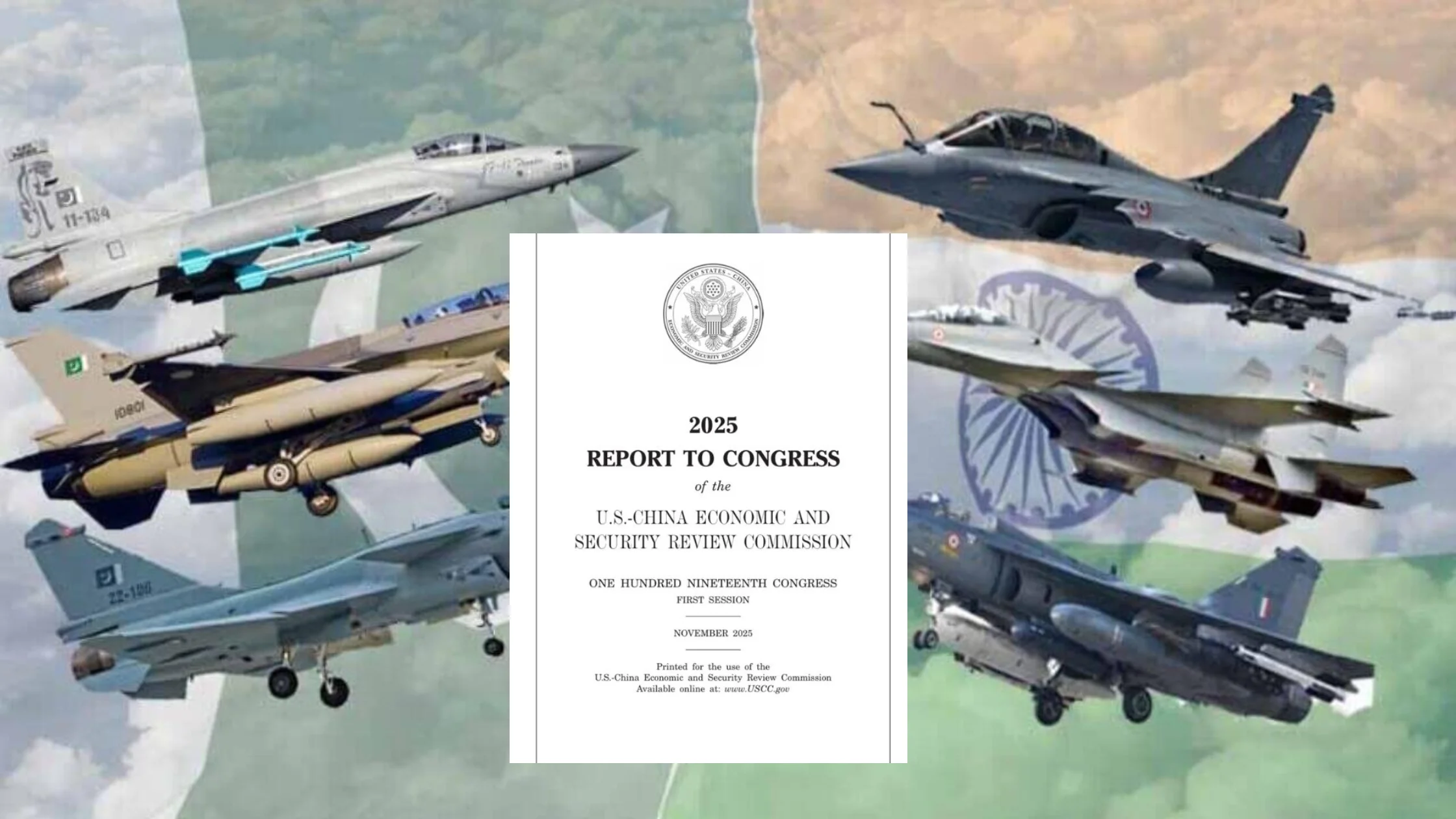
In a striking conclusion that has attracted global attention, a recent report submitted to the US Congress Report that Pakistan gained the upper hand over India during a brief but intense four-day military conflict in May. This finding comes from the US-China Economic and Security Review Commission (USCC), a congressional body that monitors security developments related to China.
According to the report, the May 7–10 clash between Pakistan and India marked the largest military escalation between the two nuclear-armed neighbors in more than 25 years. But what stunned defense experts around the world was the commission’s assessment that Pakistan not only defended itself effectively but also achieved military success using advanced Chinese systems that were tested in real combat for the very first time.
The report goes much further than simply evaluating the brief conflict. It paints a larger picture of Pakistan’s growing military partnership with China, India’s struggles during the confrontation, and how China used this limited war as an opportunity to test its most sophisticated weapons, influence global arms markets, and project its rising power in the region.
The findings have sparked debate in Washington, New Delhi, Beijing, Islamabad, and within the global defense community. Below is a detailed breakdown of what the congressional report says, why it matters, and how it may shape future military and political dynamics in South Asia.
A Rare Admission: US Report Says Pakistan “Won a Victory”
The most eye-catching part of the USCC document is its direct and unambiguous statement:
Pakistan won a military victory over India in the May conflict.
This is a remarkable assertion coming from a US congressional body—especially given the United States’ long-standing strategic ties with India. The report notes that Pakistan’s successful retaliation and defense operations made a significant impact on the battlefield and influenced post-conflict perceptions around the world.
The commission’s report describes the clashes as involving:
- missile engagements
- drone attacks
- artillery exchanges
- air-to-air combat involving modern jets
It emphasizes that Pakistan’s response was carefully coordinated, strategically executed, and made possible by Chinese weapons, Chinese intelligence inputs, and real-time battlefield support systems.
India, meanwhile, was portrayed as struggling with operational challenges, battlefield coordination issues, and vulnerabilities related to its imported weapons platforms.
China’s Decisive Role: High-Tech Systems Tested in Real Combat
One of the most important themes in the report is China’s deep involvement. While both Pakistan and China rejected claims that China provided operational guidance during the conflict, the congressional commission stated that India accused China of offering “live inputs” on more than 100 Indian military positions.
Whether these accusations are fully accurate or not, the report emphasizes that Pakistan’s battlefield performance effectively became a live demonstration of China’s newest weapons. These systems included:
- HQ-9 long-range surface-to-air missile system
- PL-15 beyond-visual-range air-to-air missiles
- J-10C Chengdu multi-role fighters equipped with AESA radar
According to the USCC, this was the first real-world combat test for several Chinese technologies. Their performance, as observed by global military experts, reportedly impressed many countries—while raising concerns for others.
China, the report notes, “leveraged the conflict” to study how its systems performed under real battlefield conditions against Western and Russian-made Indian equipment.
Rafale Jet Controversy: Pakistan Claims Shootdowns, India Denies Them
One of the most controversial aspects of the report concerns the French-made Rafale fighter jets that India has long promoted as its most advanced combat aircraft.
According to the USCC report, Pakistan used Chinese systems to shoot down multiple Indian aircraft, and Pakistan’s claims include the downing of Rafale jets. The commission says that while there are conflicting reports about the exact number, the incident created a global ripple effect.
The congressional report mentions that former US President Donald Trump publicly stated he believed five Indian jets were shot down, although his comments were not backed by official US intelligence disclosures.
What is confirmed in the report is that:
- India did suffer aircraft losses,
- India did not publicly disclose accurate numbers, and
- China used Pakistan’s claims—true or exaggerated—to market its weapons to foreign buyers.
The findings had real consequences in the defense market. According to the report:
Indonesia halted its planned Rafale purchase
after studying how Pakistan’s Chinese weapons performed against Indian Rafales.
This, the USCC says, damaged the global reputation of the Rafale platform and raised questions about its survivability against Chinese air defense and missile systems.
China’s Information Campaign: AI Imagery, Social Media Influence, and Arms Marketing
One of the most fascinating revelations in the report is China’s use of information warfare, including:
- AI-generated images
- fake social media accounts
- digital propaganda campaigns
The purpose, according to French intelligence cited in the commission’s report, was to undermine Rafale sales internationally and promote Chinese fighters—particularly the J-35 fifth-generation stealth aircraft.
Shortly after the conflict, China reportedly offered Pakistan:
- 40 J-35 jets
- KJ-500 airborne early warning aircraft
- advanced ballistic missile defense systems
The congressional report states that these tremendous offers were part of China’s long-term goal of making Pakistan its strongest military partner and positioning Chinese weapons as top-tier alternatives to Western and Russian systems.
Air India Seeks Chinese Airspace Access After Pakistan’s Flight Ban: Media Report
Pakistan’s Defence Budget Soars Despite Economic Crisis
In the wake of the conflict, Pakistan made a surprising decision:
it increased its defence budget by 20 percent, raising spending to USD 9 billion, even though the country reduced its overall national budget.
The congressional report interprets this as a sign of Pakistan’s focus on:
- maintaining technological parity
- preparing for future conflict scenarios
- expanding its Chinese-backed defense modernization programs
The USCC warns that this deepening military cooperation is reshaping regional security and reducing India’s long-term strategic advantages.
India’s Position: Mixed Claims, Limited Transparency
India’s official version of the events conflicts sharply with Pakistan’s and the USCC’s findings. Indian officials claim:
- They downed Pakistani Chinese-made fighters
- They shot down American-built F-16s used by Pakistan
- They minimized their own aircraft losses
However, the report says India provided no evidence, and no independent sources verified these claims.
The USCC also points out that India used a mix of Rafales, Su-30MKIs, Mirage 2000s, and MiG aircraft during the conflict—some of which faced operational limitations.
The commission stopped short of taking Pakistan’s claims at face value but concluded that, regardless of the exact tally:
Pakistan gained the strategic advantage, and China benefited the most politically and militarily.
China–Pakistan Military Partnership: Stronger Than Ever
The report highlights several recent joint military initiatives between the two countries:
- Warrior-VIII joint counterterrorism drills (Nov–Dec 2024)
- Chinese Navy participation in the AMAN multinational exercises (Feb 2025)
- Pakistan’s heavy reliance on Chinese imports for 81–82% of its military equipment between 2019–2023
This partnership is described as deep, rapidly growing, and strategically important for both sides.
The commission warns that China is expanding its influence in South Asia by strengthening Pakistan, while India faces increasing pressure on multiple fronts, including border tensions with China in the Himalayas.
Global Implications: A New Military Balance in South Asia?
The USCC report suggests that the May conflict may have changed long-standing perceptions about military power in South Asia:
- Pakistan demonstrated unexpected battlefield effectiveness.
- India’s modern imported systems faced performance challenges.
- China emerged as a quiet but decisive beneficiary of the conflict.
- Global arms markets are shifting toward China’s favor.
The commission emphasizes that this development is important for the United States, which sees India as a counterweight to China. The findings could significantly influence future US defense cooperation and policy calculations in the Indo-Pacific region.
Silence from China and India
Despite the extensive details in the report:
- China has not officially commented on the performance of its weapons or its role in the conflict.
- India has completely avoided responding to the congressional findings.
Both countries appear to be maintaining silence for strategic reasons.
Conclusion: A Conflict That Redefined Regional Power Dynamics
The US congressional report offers one of the clearest external evaluations yet of the brief but high-impact Pakistan–India conflict. While public narratives in India and Pakistan remain polarized, the USCC frames the clash as a strategic win for Pakistan, a major validation for Chinese weapons, and a serious embarrassment for Indian defence planners.
More importantly, it signals that the military balance in South Asia — long assumed to favor India due to its size, economy, and Western backing — is far more complex than previously believed.
As geopolitical tensions rise and China deepens its footprint in the region, the aftershocks of this short conflict are likely to shape policy decisions, military planning, and diplomatic relations for years to come.