

The Federal Government has unveiled a series of important proposals in Budget 2026-27 aimed at providing financial relief to government employees, armed forces personnel, and pensioners while introducing revised income tax rates for salaried individuals. The measures include a 7 percent Adhoc Relief Allowance, a 7 percent increase in pensions, higher conveyance allowances, revisions to special allowances, and the introduction of new pay scales.
At the same time, salaried employees across Pakistan are closely examining the proposed income tax structure to determine how much tax they will pay on their monthly earnings and how much take-home salary they can expect after deductions.
The budget proposals come at a time when inflation continues to affect household budgets, making salary adjustments and tax reforms critical for millions of workers and retirees nationwide.
New Salary Tax Structure for Salaried Individuals
Under the proposed tax framework, salaried employees will continue to pay income tax based on their annual earnings. The revised tax calculations indicate varying levels of tax liability depending on income brackets.
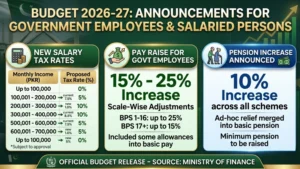
The following table provides an estimate of monthly and annual tax deductions along with net income after tax.
| Monthly Gross Salary | Annual Gross Salary | Monthly Tax | Annual Tax | Monthly Net Income | Annual Net Income |
|---|---|---|---|---|---|
| Rs. 50,000 | Rs. 600,000 | Rs. 0 | Rs. 0 | Rs. 50,000 | Rs. 600,000 |
| Rs. 100,000 | Rs. 1,200,000 | Rs. 500 | Rs. 6,000 | Rs. 99,500 | Rs. 1,194,000 |
| Rs. 200,000 | Rs. 2,400,000 | Rs. 13,000 | Rs. 156,000 | Rs. 187,000 | Rs. 2,244,000 |
| Rs. 300,000 | Rs. 3,600,000 | Rs. 34,667 | Rs. 416,000 | Rs. 265,333 | Rs. 3,184,000 |
| Rs. 400,000 | Rs. 4,800,000 | Rs. 62,000 | Rs. 744,000 | Rs. 338,000 | Rs. 4,056,000 |
| Rs. 500,000 | Rs. 6,000,000 | Rs. 92,000 | Rs. 1,104,000 | Rs. 408,000 | Rs. 4,896,000 |
| Rs. 600,000 | Rs. 7,200,000 | Rs. 124,500 | Rs. 1,494,000 | Rs. 475,500 | Rs. 5,706,000 |
| Rs. 700,000 | Rs. 8,400,000 | Rs. 159,500 | Rs. 1,914,000 | Rs. 540,500 | Rs. 6,486,000 |
| Rs. 800,000 | Rs. 9,600,000 | Rs. 194,500 | Rs. 2,334,000 | Rs. 605,500 | Rs. 7,266,000 |
| Rs. 900,000 | Rs. 10,800,000 | Rs. 229,500 | Rs. 2,754,000 | Rs. 670,500 | Rs. 8,046,000 |
| Rs. 1,000,000 | Rs. 12,000,000 | Rs. 264,500 | Rs. 3,174,000 | Rs. 735,500 | Rs. 8,826,000 |
7 Percent Salary Increase for Federal Government Employees
One of the most significant proposals in Budget 2026-27 is the grant of a 7 percent Adhoc Relief Allowance for federal government employees.
According to budget proposals, the allowance will be calculated on the running basic pay of employees and will be applicable from July 1, 2026. The move aims to provide partial relief against inflation and rising living costs.
Government employees have been demanding salary adjustments due to increasing expenses related to housing, transportation, utilities, healthcare, and education. The proposed increase is expected to benefit employees across various ministries and departments.
Although many employee associations were hoping for a larger increase, the proposed 7 percent raise is being viewed as an effort to balance fiscal constraints with employee welfare.
Government Plans to Expand MRP-Based Tax System to More FMCG Items in Budget 2026–27
Federal Budget 2026–27 Expected to Be a Turning Point for Pakistan’s Economy
Punjab Budget 2026-27 to Be Presented on June 16, Focus on Public Relief and Fiscal Discipline
Introduction of New Pay Scales 2026
The government has also proposed introducing Pay Scales 2026 through the merger of previous relief allowances into the basic pay structure.
Under the proposal:
- Adhoc Relief Allowance 2022 (15% of basic pay) will be merged.
- Adhoc Relief Allowance 2025 (10% of basic pay) will also be incorporated.
- New pay scales will be implemented subject to prescribed conditions.
The restructuring of pay scales is expected to simplify salary calculations and improve long-term benefits for government employees by incorporating previous allowances into the permanent pay structure.
This move could also positively impact future pension calculations and annual increments.
Disparity Reduction Allowance to Continue
The government has proposed the continuation of the Disparity Reduction Allowance (DRA) 2026.
The allowance will remain available for employees from BPS-1 to BPS-22 who are already receiving it under existing rules and conditions.
The DRA is calculated at 15 percent of the basic pay as of June 30, 2022, and was originally introduced to reduce salary differences among employees working in various government departments.
The continuation of this allowance provides additional financial support to thousands of employees across the federal government.
Major Increase in Conveyance Allowance
Transportation expenses have become a significant burden for employees due to rising fuel prices and commuting costs.
Recognizing this challenge, the government has proposed increasing the Conveyance Allowance by 50 percent.
The increase is expected to benefit employees who travel daily to workplaces and government offices. It may also help offset some of the impact of inflation on transportation costs.
Many employee representatives have welcomed the proposal, arguing that transportation expenses have increased substantially over the past few years.
Constant Attendant Allowance Increased to Rs. 30,000
The budget also proposes a substantial increase in the Constant Attendant Allowance for Civil Armed Forces personnel.
The allowance is proposed to increase from Rs. 7,000 per month to Rs. 30,000 per month.
This represents one of the largest percentage increases among all allowances announced in the budget proposals. The increase aims to provide better support to eligible personnel who require constant assistance due to service-related conditions.
Special Allowances Revised for Various Departments
Several government institutions are also expected to benefit from revised special allowances.
Departments included in the proposed revisions include:
- Pakistan Coast Guards
- Immigration and Passport Department
- National Counter Terrorism Authority (NACTA)
- National Forensics and Investigations Agency (NFIA)
- Frontier Constabulary
- National Highways and Motorway Police (NHMP)
- National Police Academy
The government believes these revisions are necessary to compensate employees working in specialized and demanding roles.
Cabinet Division Employees to Receive Higher Special Pay
Employees working in the Cabinet Division and Cabinet Committees Wings may also receive enhanced compensation under Budget 2026-27.
The proposed revision would increase special pay from Rs. 6,000 to Rs. 20,000 per month.
This increase reflects the importance of administrative and policy-making functions performed within these divisions.
The move is expected to improve employee motivation and retention within key government institutions.
Special Conveyance Allowance Also Increased
Another notable proposal is the increase in the Special Conveyance Allowance.
Under the revised framework, the allowance is expected to rise from Rs. 6,000 to Rs. 10,000 per month.
This increase provides additional support for employees who require transportation assistance due to special circumstances.
Combined with the broader increase in conveyance allowance, the measure highlights the government’s focus on addressing transportation-related financial challenges.
7 Percent Pension Increase for Retired Employees
Pensioners are also expected to receive relief under Budget 2026-27.
The government has proposed a 7 percent increase in baseline pensions in accordance with Finance Division pension policies.
Retired government employees have been particularly vulnerable to inflation due to fixed incomes and rising healthcare costs. The proposed increase aims to improve financial stability for pensioners and help them manage growing living expenses.
The pension adjustment is expected to benefit thousands of retired civil servants and former members of the armed forces across Pakistan.
What These Measures Mean for Employees and Pensioners
The combined impact of salary increases, revised allowances, new pay scales, and pension enhancements is expected to provide some relief against inflationary pressures.
Government employees may benefit from:
- 7% Adhoc Relief Allowance
- Revised Pay Scales 2026
- Continued Disparity Reduction Allowance
- 50% increase in Conveyance Allowance
- Higher Special Allowances
- Improved transportation-related benefits
Pensioners will benefit from:
- 7% increase in baseline pensions
- Improved long-term pension sustainability through pay scale reforms
While some employee groups believe additional relief is needed, the proposed measures represent one of the most comprehensive compensation packages introduced in recent years.
Conclusion
Budget 2026-27 introduces important financial measures for salaried individuals, government employees, armed forces personnel, and pensioners. The revised salary tax structure provides greater clarity regarding tax liabilities, while the proposed 7 percent salary and pension increases aim to reduce the impact of inflation.
The introduction of Pay Scales 2026, continuation of the Disparity Reduction Allowance, significant increases in conveyance benefits, and revisions to special allowances collectively demonstrate the government’s effort to support public sector employees and retirees.
As the budget moves through the approval process, millions of Pakistanis will closely monitor the final decisions and their impact on personal finances, take-home salaries, and retirement benefits.
Frequently Asked Questions
Will government employees receive a salary increase in Budget 2026-27?
Yes, a 7% Adhoc Relief Allowance has been proposed for federal government employees.
How much pension increase is proposed?
The government has proposed a 7% increase in baseline pensions.
What is the new Conveyance Allowance proposal?
The existing Conveyance Allowance is proposed to increase by 50%.
Will the Disparity Reduction Allowance continue?
Yes, it is proposed to continue for eligible BPS-1 to BPS-22 employees.
When will the new salary and pension measures take effect?
The proposals are expected to take effect from July 1, 2026, subject to final approval.