

USA President Donald Trump May 2025 visit to Riyadh marked a watershed moment in Middle East geopolitics. The three-day summit resulted in unprecedented economic agreements, significant diplomatic breakthroughs, and a fundamental reshaping of technological partnerships between the United States and Saudi Arabia. This in-depth analysis examines the multiple dimensions of this historic visit, from the $600 billion in announced deals to the conspicuous absence of Gaza war discussions, providing context and insights into what these developments mean for the future of the region.
Donald Trump Royal Welcome and Summit Overview
US President Donald Trump arrival at King Khalid International Airport set the tone for the entire visit. A lavish purple carpet reception hosted by Crown Prince Mohammed bin Salman (MBS) symbolized the warming relations between the two nations, starkly contrasting with the previous administration’s stance. The summit brought together an unprecedented delegation of American business leaders, including tech titans like Elon Musk, Nvidia’s Jensen Huang, and AMD’s Lisa Su, alongside defense contractors and energy executives. This convergence of political and corporate power underscored the visit’s dual focus on economic partnership and geopolitical strategy.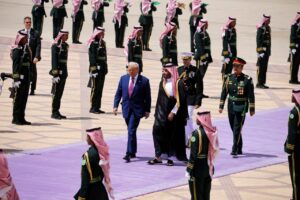
Donald Trump Breakdown of the $600 Billion Economic Package
The centerpiece of the summit was the announcement of $600 billion in mutual investments, though subsequent analysis revealed the immediate commitments totaled approximately $282 billion. The defense sector accounted for the largest portion, with a $142 billion arms deal that included advanced F-35 fighter jets and THAAD missile defense systems. Energy and infrastructure projects followed at $188 billion, featuring massive contracts for Neom smart city development and renewable energy initiatives. The technology sector emerged as perhaps the most transformative, with $270 billion allocated for AI development and data infrastructure, signaling Saudi Arabia’s determined pivot toward a post-oil economy.
Who Is Pakistani-American Judge Loren L. AliKhan Who Blocked Trump’s Aid Freeze Order?
The Technology Revolution: AI as the New Oil
Saudi Arabia’s Vision 2030 ambitions took center stage through several groundbreaking tech announcements. Nvidia committed to building AI “factories” with 500 megawatts of capacity, while AMD’s $10 billion investment will develop sovereign AI capabilities. Perhaps most significantly, Saudi data firm DataVolt pledged $20 billion to construct AI data centers across the United States. These partnerships reflect a strategic calculation by both nations for the Saudis, access to cutting-edge technology; for American firms, a lucrative market and geopolitical hedge against Chinese influence in the region.
Diplomatic Maneuvers: Syria and the Abraham Accords
In one of the visit’s most unexpected developments, President Trump announced the lifting of U.S. sanctions on Syria following a meeting with interim President Ahmad al-Sharaa. This policy reversal came with strict conditions, including Syrian participation in the Abraham Accords and cooperation against ISIS. The move represents a pragmatic, if controversial, shift toward stability-focused diplomacy in the region. Meanwhile, discussions about Saudi Arabia joining the Abraham Accords remained inconclusive, with MBS maintaining that normalization with Israel would only occur when conditions were right, particularly regarding Palestinian statehood.
The Elephant in the Room: Gaza’s Conspicuous Absence
Despite occurring against the backdrop of ongoing conflict in Gaza, the war received remarkably little public attention during the summit. This absence spoke volumes about the priorities of both administrations. While Israeli officials reportedly sought to arrange a stop in Jerusalem, Trump’s team declined without a ceasefire or significant diplomatic breakthrough to announce. The omission suggests a calculated decision to prioritize economic and technological agreements over the intractable Israeli-Palestinian conflict, at least in the short term.
Regional Reactions and Global Implications
The summit’s outcomes sent ripples across the Middle East and beyond. Iran condemned the strengthened U.S.-Saudi alliance, while Israel expressed cautious optimism about potential normalization. European allies raised concerns about the arms deals’ regional impact, and Chinese officials watched warily as American firms secured dominant positions in Saudi Arabia’s tech infrastructure. These developments position the U.S. as the primary external power in shaping the Middle East’s technological future, potentially marginalizing both Chinese and Russian influence in the region.
Conclusion: Assessing the Long-Term Impact
US President Trump’s Riyadh summit may represent a defining moment in 21st-century Middle East relations. The sheer scale of economic commitments, particularly in technology and defense, creates deep, structural ties between the U.S. and Saudi economies that will likely endure beyond any single administration. The diplomatic moves on Syria suggest a more pragmatic approach to regional conflicts, while the continued expansion of the Abraham Accords framework keeps the possibility of Saudi-Israeli normalization alive. However, the unresolved Gaza conflict and ethical questions about the Trump Organization’s regional business interests loom as potential challenges to this emerging order. As the dust settles, the summit’s true legacy will be determined by how these ambitious announcements translate into concrete outcomes in the coming years.