

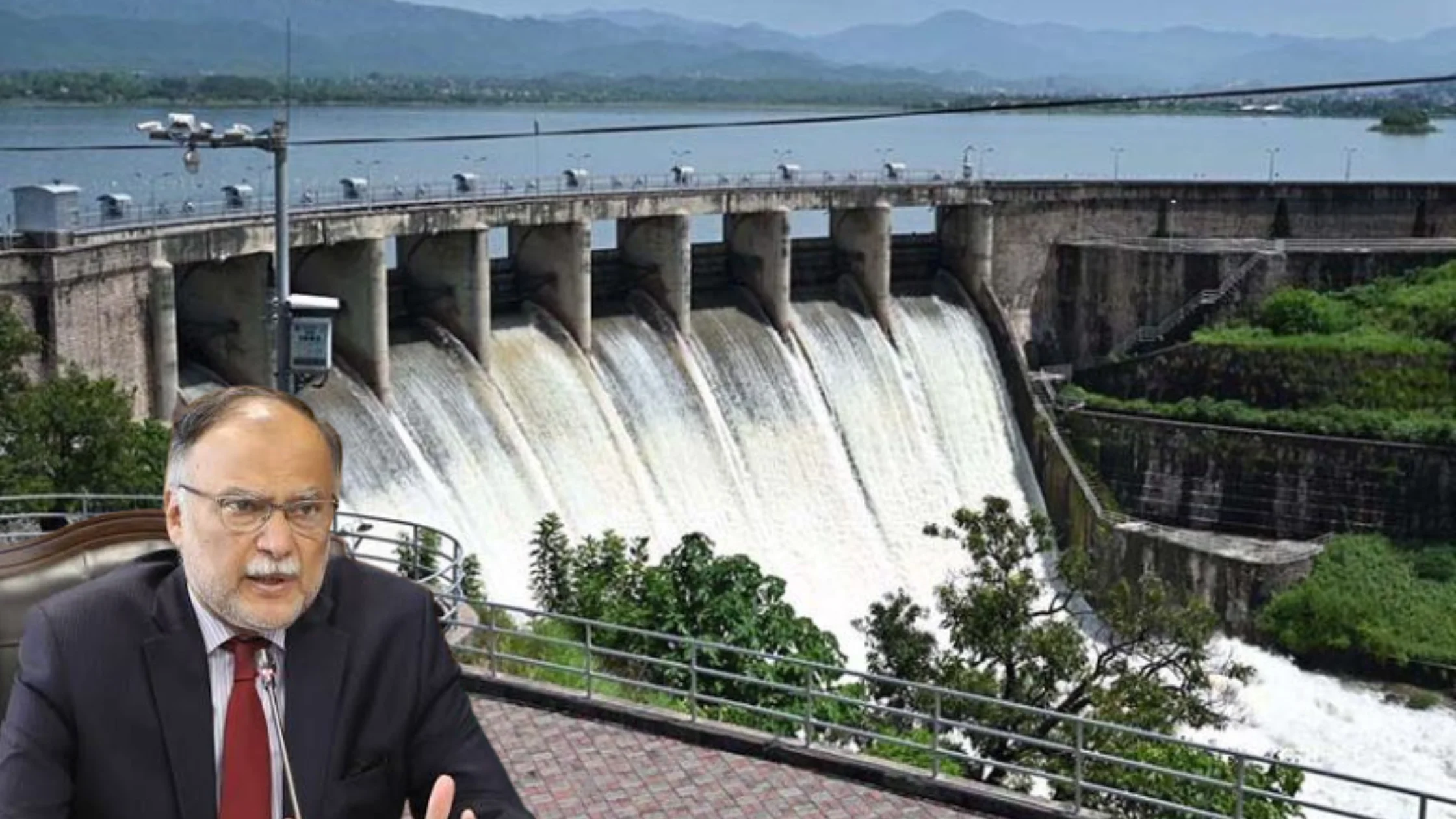
Federal Minister for Planning, Development and Special Initiatives Ahsan Iqbal has strongly criticized what he described as India’s “water aggression,” reaffirming that Pakistan will protect its water rights through diplomatic, legal, and international channels. His remarks come amid growing tensions over India’s unilateral suspension of the Indus Waters Treaty (IWT), a landmark water-sharing agreement that has regulated the use of the Indus River system between the two countries for more than six decades.
Speaking to the media, Ahsan Iqbal said Pakistan considers any attempt to restrict or manipulate water flows under the treaty to be unacceptable. He stressed that water is a vital national resource directly linked to Pakistan’s agriculture, food security, economy, and the livelihoods of millions of people. According to the minister, the government is fully committed to defending the country’s rights under international law and ensuring that no action undermines Pakistan’s access to its allocated share of water.
Iqbal revealed that the issue has been raised at every major international platform available to Pakistan. He said he personally highlighted India’s actions during his recent visit to the United States, including discussions at the United Nations General Assembly (UNGA) in New York. During his meetings, he urged the international community to take serious notice of the dispute and encourage a peaceful resolution based on international agreements and legal obligations.
Pakistan Confirms Historic Debut in Inaugural FIFA Asian Cup
The minister noted that Pakistan’s position has received encouraging support from several international stakeholders, who recognize the importance of respecting international treaties and preventing water disputes from escalating into broader regional tensions. He emphasized that international agreements such as the Indus Waters Treaty should not be suspended unilaterally and must continue to be honored by both parties.
The Indus Waters Treaty, signed in 1960 with the support of the World Bank, is regarded as one of the world’s most successful transboundary water-sharing agreements. It allocates the waters of the eastern rivers—Ravi, Beas, and Sutlej—to India, while granting Pakistan rights over the western rivers—Indus, Jhelum, and Chenab. Despite multiple wars and decades of political tensions, the treaty has historically remained in force and has been considered a key mechanism for maintaining cooperation over shared water resources.
Experts believe that prolonged uncertainty surrounding the treaty could have serious consequences for Pakistan, where agriculture contributes significantly to the national economy and relies heavily on irrigation from the Indus River system. Any disruption in water availability could affect crop production, food security, hydropower generation, and rural livelihoods, making the issue a matter of national importance.
Reaffirming the government’s position, Ahsan Iqbal said Pakistan will continue to pursue diplomatic engagement while defending its legal rights under international law. He expressed hope that the global community would play a constructive role in ensuring that existing international agreements are respected and that water remains a source of cooperation rather than conflict between neighboring countries.