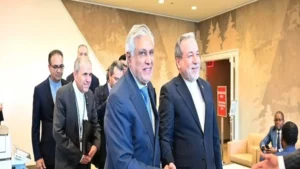


Prime Minister Shehbaz Sharif has arrived in the United States to attend the global summit of the Board of Peace, an initiative convened by former President Donald Trump. The high-level meeting brings together leaders from more than 20 countries to discuss the future of Gaza and broader international peace efforts.
The summit is taking place in Washington and focuses on three main goals. First, consolidating the ceasefire in Gaza that was negotiated in October with help from the US, Qatar, and Egypt. Second, securing financial commitments for reconstruction. And third, outlining how this new international body will work going forward.
The Board of Peace and Its Funding
Washington has announced an initial pledge of $5 billion toward Gaza reconstruction and humanitarian efforts. Trump is expected to reveal more details about how this money will be used to rebuild the territory, where the vast majority of buildings lie in rubble after months of devastating conflict.
The Board of Peace operates under a unique structure. Trump will serve as chairman with significant authority, including veto power over decisions. He can remain head even after leaving office. Countries wanting permanent membership rather than a two-year term must pay $1 billion.
Several Muslim-majority nations have joined the initiative, including Saudi Arabia, Turkey, Egypt, Qatar, Indonesia, and Pakistan. However, many traditional US allies like France, Germany, and Canada have declined to participate, expressing concerns the board could undermine existing UN mechanisms.
Shehbaz Sharif Highlights Landmark Visit to Austria
The International Stabilisation Force
A key topic on the agenda is the proposed International Stabilisation Force, which would be tasked with securing reconstruction areas and supporting governance in Gaza after the conflict ends. The force, backed by a UN mandate, would help maintain security and allow Israel to begin withdrawing from territory it still occupies.
Indonesia has emerged as a major potential contributor, with President Prabowo Subianto indicating readiness to send up to 8,000 troops if the force is confirmed. Jakarta has already prepared about 1,000 soldiers as a first batch for potential deployment by early April.
Other countries considering participation include Morocco, Greece, and Albania. Reports suggest Morocco may become the first Arab country to officially join this international formation. Greece plans to contribute a battalion of 100-150 personnel with armored vehicles, marking its first ground force mission since Afghanistan.
Pakistan’s Position on Troop Deployment
For Pakistan, the possibility of contributing troops has gained attention following reported discussions between military leaders and US officials. However, Islamabad has made its position crystal clear: any deployment must be strictly limited to peacekeeping and reconstruction purposes.
“We are ready to send troops. Let me make it clear that our troops could only be part of a peace mission in Gaza,” said a close aide to PM Shehbaz. “We will not be part of any other role, such as disarming Hamas. It is out of the question.”
Officials say Pakistan could potentially deploy thousands of troops, but only after receiving full clarity on the ISF’s objectives, chain of command, and operational authority. The government wants assurances this will be a peacekeeping mission rather than a combat role.
Analysts note that Pakistan’s military experience, including conventional warfare and counterinsurgency operations, makes it a valuable contributor to a multinational force.
Regional Dynamics and Concerns
Several Muslim-majority countries have expressed willingness to join the stabilisation mechanism but share similar concerns about the mission’s scope. They are reluctant to assume roles that could place their forces in direct engagement with Hamas and are seeking clarity on the political roadmap for Palestinian statehood.
Indonesia has stressed that any military participation does not mean recognition of Israel or normalization of relations. Jakarta insists its forces will perform humanitarian and non-combatant tasks only, and requires explicit approval from the Palestinian Authority before sending any soldiers.
Meanwhile, Israel has expressed opposition to Pakistan playing any executive role in Gaza. Israeli Ambassador to India Reuven Azar stated that Israel is not interested in allowing countries “that are not conducive to promoting moderation and peace” to have such involvement.
The Disarmament Challenge
One of the thorniest issues remains the disarmament of Hamas. The second phase of the ceasefire agreement focuses on this goal, but experts acknowledge it will not be a simple task. Trump has stated that “complete and immediate” disarmament of Hamas is essential to any lasting settlement.
Israeli officials have suggested sweeping restrictions, including seizing small personal rifles from Hamas members. However, regional allies do not want Israel to use lack of progress on disarmament as an excuse to resume military operations.
US officials acknowledge they are under no illusions about the challenges but say mediators have reported encouraging signs. Some suggest there may be parallel tracks of deploying troops and beginning reconstruction while working on disarmament as a longer-term process.
Broader Implications
The Board of Peace represents Trump’s vision for reshaping international conflict resolution, though critics describe it as “a confused mix of ambition and narcissism.” Some warn it could become a rival to the United Nations, while supporters see it as a fresh approach to persistent global conflicts.
During his visit, PM Shehbaz may hold bilateral meetings with Trump either on the sidelines or at the White House following the summit. He is also scheduled to meet with Secretary of State Marco Rubio at the State Department.
Pakistan frames its participation as a step toward ending Palestinian suffering and supporting a permanent ceasefire under UN resolutions. Islamabad reaffirms its commitment to Palestinian self-determination, advocating for an independent state within pre-1967 borders with Al-Quds Al-Sharif as its capital.