In recent years, discussions around the Pakistan missile range have taken a more serious tone globally. From solid-fuel rocket motors to satellite imagery of test stands, it seems Islamabad’s ambitions are climbing higher both figuratively and literally. But is Pakistan really developing missiles that could reach as far as the United States? Or is it simply securing its backyard? Let’s unpack everything.
Historical Overview of Pakistan’s Missile Range Evolution
The Beginnings – Hatf and Beyond
Pakistan’s missile journey began in the late 1980s with the Hatf series. These early designs were short-range systems aimed squarely at India. But as time passed, political rivalries and defense needs pushed Pakistan into more sophisticated territories.
Strategic Drivers Behind Missile Development
Security concerns—especially from India—have always been the fuel behind Pakistan’s missile program. Nuclear parity is crucial to Islamabad, and thus, an evolving and diversified missile arsenal became the backbone of its national defense.
Breakdown of Major Pakistani Missile Systems
Shaheen Series
The Shaheen missiles are the crown jewels of Pakistan’s strategic missile force.
Shaheen-I
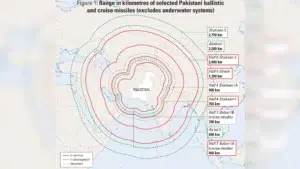
A short-range ballistic missile (SRBM) with a range of around 750 km. Perfect for striking tactical targets within Indian territory.
Shaheen-II
Upgraded to cover 2,000 km, capable of hitting deep into Indian territory.
Shaheen-III – Pakistan’s longest-range missile
The Shaheen-III, with a range of 2,750 km, is the longest publicly acknowledged missile in Pakistan’s arsenal. It can hit India’s Andaman and Nicobar Islands—strategic outposts currently unreachable by older missiles.
Ghauri Series
The Ghauri series, based on North Korean technology, was Islamabad’s first attempt at liquid-fueled missiles, offering flexibility but with operational complexity.
Ababeel – Pakistan’s MIRV Technology
This missile uses Multiple Independently Targetable Reentry Vehicles (MIRVs) to counter India’s missile defenses. Though its range is 2,200 km, the MIRV payload makes it a strategic beast.
Pakistan Missile Range vs India: Strategic Balancing
How Pakistan Matches India’s Advancements
India’s acquisition of Agni-V (with a range over 5,000 km) compelled Pakistan to explore longer-range capabilities—even if quietly. The Pakistan missile range appears reactionary rather than aggressive.
MIRV vs BMD: The Deterrence Game
As India develops Ballistic Missile Defense (BMD) systems, Pakistan counters with MIRV-equipped missiles like Ababeel. It’s a high-stakes chess game of offense vs defense.
The Shadow of the ICBM – Is Pakistan missile range Going Global?
US Concerns About a Potential ICBM
The US alleges that Pakistan may be working on a missile capable of traveling 10,000+ km—a claim that Islamabad flatly denies. Washington’s concern stems from rocket motor test site expansions and imported tech components.
Satellite Evidence and Rocket Motor Testing
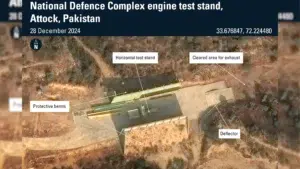
Between 2021 and 2023, a large test stand appeared in Attock. This site is tailored for testing large-diameter rocket motors—hinting at ambitions beyond South Asia.
The Taimur missile: Reality or Speculation?
Rumors around the “Taimur” ICBM with a 7,000+ km range persist. But no official confirmation exists. As of now, it remains speculation, though unsettling for global observers.
China’s Role in Expanding Pakistan missile range
Technology Transfers and Strategic Partnerships
Chinese companies have allegedly supplied D-glass fiber, quartz fabric, and filament winding machines—all used in missile motor case manufacturing.
US Sanctions and Chinese Companies
The US sanctioned four Pakistani entities and several Chinese firms believed to be aiding in expanding the Pakistan missile range. Still, these actions haven’t entirely deterred progress.
Dual-Use Dilemma – Civilian vs Military Applications
Space Vision 2047 – Civilian Projects
Pakistan’s “Space Vision 2047” includes aspirations for space exploration but makes no clear mention of SLVs (Space Launch Vehicles). Could the larger rocket motors be for peaceful space goals?
Larger Rocket Motors for SLVs?
There’s potential overlap. The same technology used in ICBMs can power SLVs. But as of now, Pakistan seems more focused on military deterrence than space exploration.
Challenges and Setbacks in Missile Development
International Sanctions
Sanctions from the US and its allies have impacted imports and slowed development but haven’t halted it—especially with China’s support.
Indigenous Capability Gaps
Despite progress, Pakistan lacks full self-reliance. It still relies heavily on foreign tech and raw materials.
The Most Safe Countries in the World if World War III Happened
The Role of National Defence Complex (NDC) in Pakistan missile program
The NDC plays a central role in producing solid-propellant missiles and testing large rocket motors. It’s the nerve center of Pakistan’s missile R&D.
Full Spectrum Deterrence and Its Relevance Today
Pakistan’s missile range development fits within its Full Spectrum Deterrence doctrine. The idea is to deter all forms of aggression, from conventional to nuclear.
Is Pakistan missile range a Threat to Global Peace?
US Fears vs Ground Reality
While Washington’s claims can’t be ignored, there is no public proof of ICBMs. However, the tools and infrastructure Pakistan is acquiring do raise eyebrows.
Non-Proliferation and Regional Arms Race
The South Asian region risks being pulled into an arms race, especially as both India and Pakistan continue to develop advanced missile technologies.

Comparing Pakistan missile range with Other Countries
India
India’s Agni-V and K-series SLBMs give it an edge in long-range capabilities.
North Korea
North Korea has tested ICBMs. Pakistan, by contrast, denies any such development.
Iran
Iran’s longest-range missile (Sejjil-2) reaches 2,000–2,500 km, similar to Pakistan missile range.
What the Future Holds – Predictions for 2030 and Beyond
Technological Innovations
Expect further integration of composite materials, MIRVs, and maybe even hypersonic glide vehicles if funding and tech access continue.
Possibility of ICBM and SLBM Development
While nothing is official, infrastructure for ICBM/SLBM development seems partially in place. The next decade will be critical.
The Public and Political Reaction in Pakistan
Most citizens view the missile program as a source of national pride. Politically, it’s framed as necessary for survival in a hostile neighborhood.
Final Thoughts on Pakistan missile range
Whether Pakistan is working on an ICBM or simply bolstering its regional deterrence, one thing is clear—its missile program is evolving fast. The mix of technological ambition, strategic necessity, and international scrutiny makes this a story worth following closely.
FAQs on Pakistan missile range
Q1: What is the current maximum Pakistan missile range?
A: The maximum publicly confirmed range is 2,750 km, achieved by the Shaheen-III missile.
Q2: Is Pakistan developing an ICBM to expand its missile range?
A: While there are speculations and satellite evidence, no official confirmation of an ICBM (7,000+ km range) exists yet.
Q3: What role does China play in Pakistan missile range expansion?
A: China provides materials and equipment crucial to manufacturing long-range missile components, helping Islamabad grow its arsenal.
Q4: Are there any civilian uses for Pakistan’s new missile technology?
A: Possibly. Large rocket motors can be used for space launch vehicles, though there’s no official SLV program announced.
Q5: How does Pakistan missile range compare to India’s?
A: India’s missiles, like the Agni-V, exceed 5,000 km. Pakistan’s longest is 2,750 km, but focuses on MIRVs and tactical deterrence.