
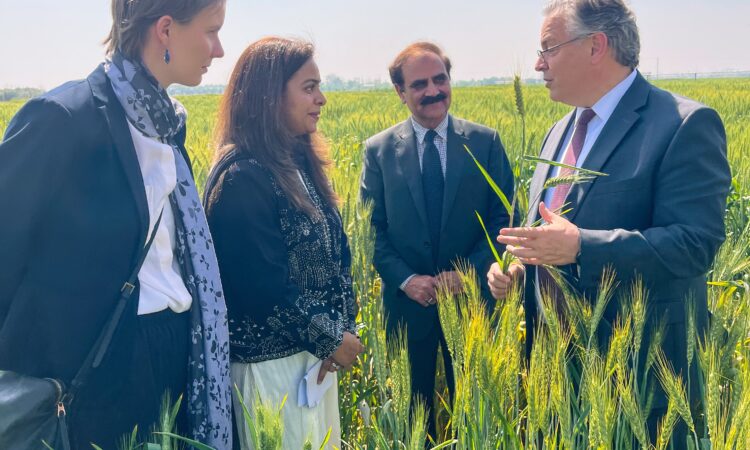
ISLAMABAD Donald Blome, the US ambassador to Pakistan, stated on Wednesday that the US and Pakistan were working together to develop new sources of income for farmers, ranchers, and foresters.
“Collaborative projects seek to support farmers in embracing climate-smart farming methods while expanding market alternatives and guaranteeing higher prices for their produce,” he declared at a celebration of the Pakistan Agricultural Development Project, a 20.9 million dollar US Department of Agriculture-funded project with many interesting achievements.
Collectively, we trained 63,000 farmers in the application of good agricultural practices. We present enhanced post-harvest processing and storage methods together with new manufacturing approaches,” he continued.
“To illustrate the advantages of these practices, we established model plots with a select group of farmers and private sector service providers,” he stated. Three date-pitting centers have been established in Khairpur and Sindh, providing jobs for 600 women, he continued.
Farmers were able to construct tomato processing units, cold storage facilities, banana packing buildings, and highly efficient drip irrigation systems thanks to assistance from Pakistan Agricultural Development. Additionally, the project improved commercial ties with companies both upstream and downstream through marketing and lending initiatives.
These achievements are a wonderful fit for the goals of the “Green Alliance” framework between the United States and Pakistan. Our nations are cooperating to preserve soil and water resources while also raising agricultural output and farmers’ incomes through the “Green Alliance,” he continued.
According to the ambassador, Pakistan’s economy is based mostly on agriculture, and both Pakistan and the United States have expanded and will continue to strengthen their cooperation in this crucial area.
We also celebrate the fact that experts from the USDA and the Ministry of National Food Security and Research collaborated to create biopesticides tailored to Pakistan’s growing circumstances, in addition to the Pakistan Agricultural Development program.
“Together, we are finalizing a regulatory framework to allow the marketing of environmentally friendly crop protection products,” stated the ambassador. Additionally, we are giving farmers equipment to help them apply fertilizers more effectively.
“To illustrate the advantages of these practices, we established model plots with a select group of farmers and private sector service providers,” he stated. Three date-pitting centers have been established in Khairpur and Sindh, providing jobs for 600 women, he continued.
Farmers were able to construct tomato processing units, cold storage facilities, banana packing buildings, and highly efficient drip irrigation systems thanks to assistance from Pakistan Agricultural Development. Additionally, the project improved commercial ties with companies both upstream and downstream through marketing and lending initiatives.
These achievements are a wonderful fit for the goals of the “Green Alliance” framework between the United States and Pakistan. Our nations are cooperating to preserve soil and water resources while also raising agricultural output and farmers’ incomes through the “Green Alliance,” he continued.