

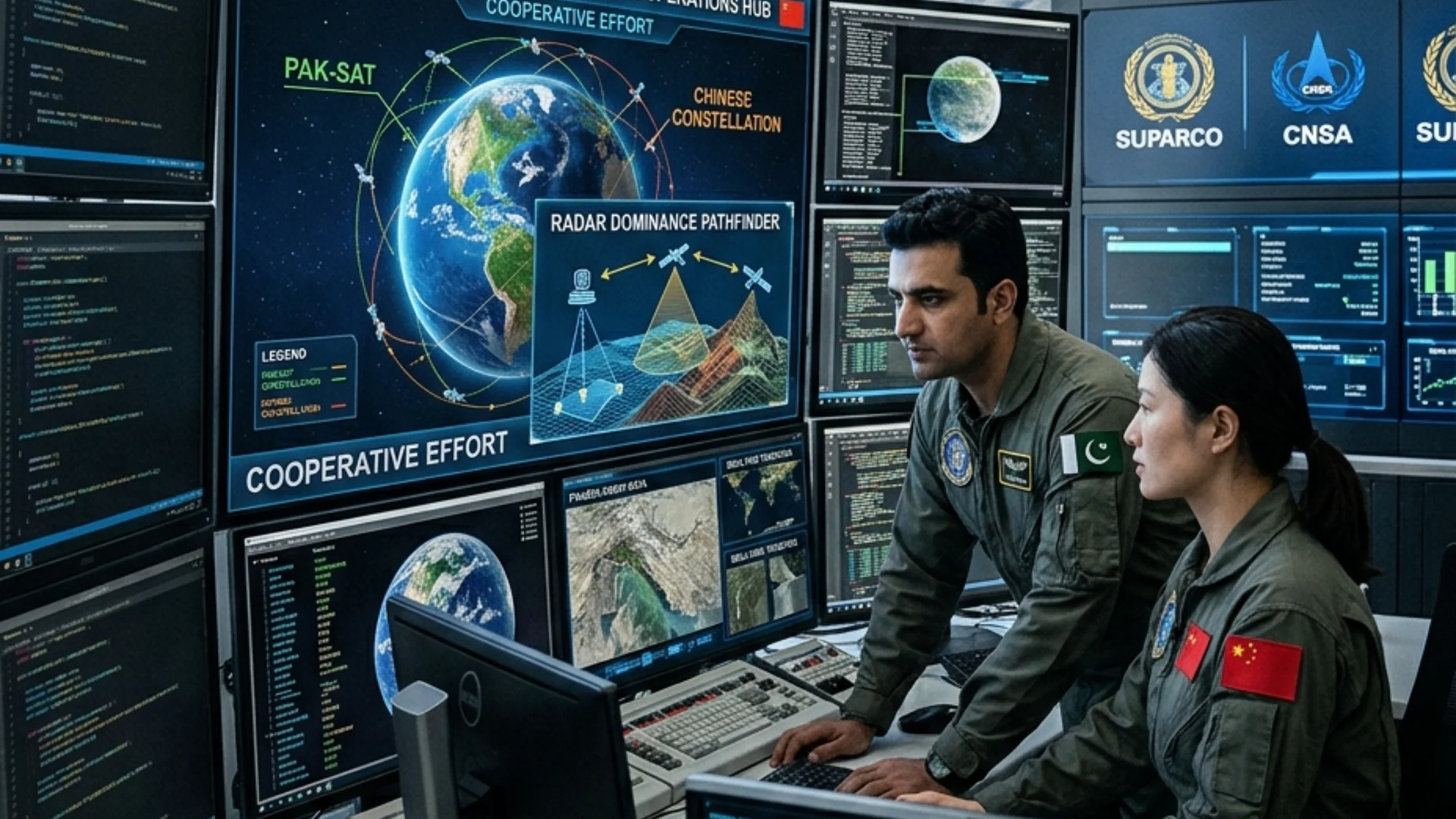
Pakistan’s growing cooperation with China in satellite technology is not just a political move—it is a strategic necessity shaped by modern warfare and technological advancement. As defense systems become more advanced, countries are no longer relying only on ground-based radars or traditional surveillance. Instead, they are building integrated networks that combine radar systems, satellites, and real-time data sharing. This is exactly where Pakistan’s recent developments come into play.
Pakistan has made significant progress by developing advanced radar systems like the AM-350S and the Machaan Radar. The AM-350S, based on AESA (Active Electronically Scanned Array) technology, can track targets up to 350 kilometers, including stealth aircraft, drones, and cruise missiles. On the other hand, the Machaan Radar is a highly mobile, indigenous 3D radar with a range of 105 kilometers, designed for close air defense. These systems are a major step toward self-reliance in defense technology, reducing dependence on foreign systems.
However, even the most advanced radar systems have limitations if they operate in isolation. Modern defense requires seamless data linking, communication, and command-and-control systems. This is where satellites become critical. By having its own presence in space, Pakistan can connect its radar networks across vast distances, ensuring real-time coordination between different defense units. Satellites act like a central nervous system, linking sensors, radars, and response units into one unified network.
Pakistan Prepares New 5-Year Auto Policy with Reduced Import Duties and Improved Standards
Cooperation with China helps Pakistan accelerate this process. China already has advanced space capabilities, including satellite launches, navigation systems, and communication networks. By working together, Pakistan gains access to technology, expertise, and infrastructure that would otherwise take decades to develop independently. This partnership is not about dependency—it is about speeding up progress and building capability faster.
In simple terms, if radar systems are the eyes, satellites are the brain that connects everything. Without strong space-based support, even the best radars cannot operate at their full potential. By strengthening its presence in space through cooperation with China, Pakistan aims to build a fully integrated defense network, improving surveillance, response time, and overall security.
This collaboration is part of a larger vision where Pakistan not only strengthens its defense but also develops its space sector for future applications like communication, disaster management, and scientific research.