
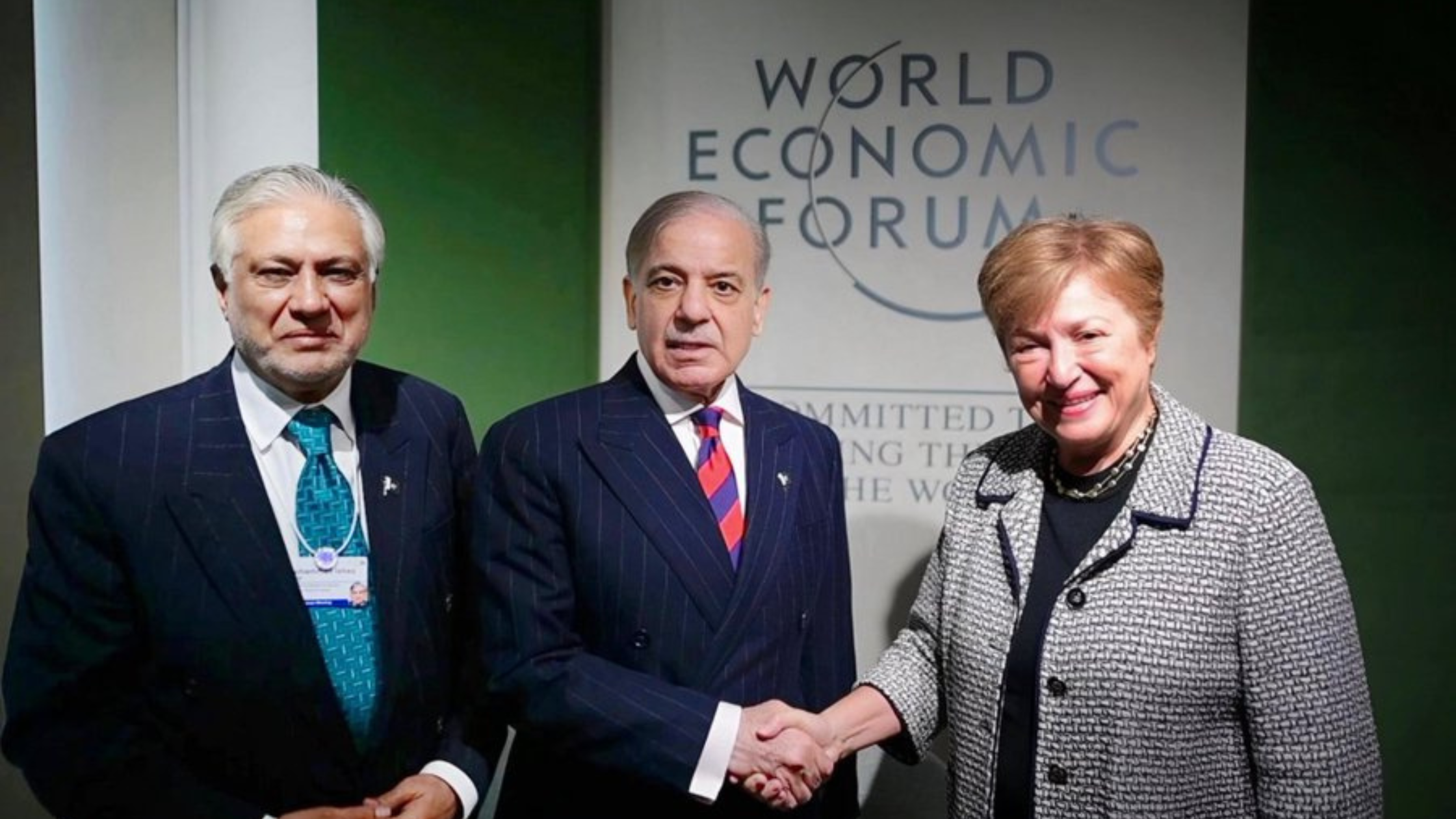
Prime Minister Shehbaz Sharif has highlighted Pakistan’s improving economic outlook during a key meeting with International Monetary Fund (IMF) Managing Director Kristalina Georgieva on the sidelines of the World Economic Forum (WEF) 2026 in Davos. The meeting reflects Pakistan’s continued engagement with international financial institutions and its efforts to restore economic stability through reforms, fiscal discipline, and sustainable growth policies.
In a message shared on social media, the prime minister described the meeting as warm and productive, noting that he was pleased to brief the IMF chief on Pakistan’s recent macroeconomic progress. He pointed out that Pakistan has shown encouraging signs of stabilization after facing significant economic challenges in recent years, including high inflation, balance-of-payments pressures, and declining foreign exchange reserves.
During the discussion, Prime Minister Shehbaz Sharif outlined key improvements in macroeconomic indicators, such as better fiscal management, controlled current account deficits, and gradual recovery in investor confidence. He emphasized that the government has taken difficult but necessary steps to stabilize the economy, including reforms in energy pricing, taxation, and public sector governance. These measures, he said, are essential to put the country on a path of long-term economic resilience.
Kristalina Georgieva acknowledged Pakistan’s efforts and appreciated the progress made under challenging circumstances. According to the prime minister, the IMF managing director recognized the government’s commitment to reform and the seriousness with which it is addressing structural weaknesses in the economy. This acknowledgment is significant, as IMF support often plays a crucial role in maintaining market confidence and unlocking additional funding from other international partners.
A major focus of the meeting was Pakistan’s commitment to fiscal discipline and revenue mobilization. Prime Minister Shehbaz Sharif reiterated that his government is determined to broaden the tax base, reduce wasteful spending, and improve transparency in public finances. He stressed that sustainable economic growth cannot be achieved without strong institutions, effective governance, and responsible financial management.
IMF Pressures Pakistan to Impose 10% Tax on Fertilizers and 5% on Agricultural Chemicals
The two leaders also exchanged views on the global economic outlook, which remains uncertain due to geopolitical tensions, high interest rates, and slowing growth in several major economies. In this context, the prime minister underlined the importance of multilateral support for developing countries that are disproportionately affected by global economic shocks. He highlighted the need for flexible and responsive international financial mechanisms to help vulnerable economies maintain stability while pursuing growth-oriented reforms.
Prime Minister Shehbaz Sharif’s participation in the World Economic Forum comes at a time when Pakistan is actively seeking to rebuild international confidence and attract foreign investment. By engaging with global leaders, financial institutions, and business executives in Davos, the government aims to project Pakistan as a country committed to reform, openness, and economic cooperation.
The meeting with the IMF chief also signals continuity in Pakistan’s engagement with the Fund. While IMF programs are often politically sensitive domestically, the government views them as necessary tools to stabilize the economy, manage external pressures, and implement long-overdue structural reforms. Officials believe that sustained engagement with the IMF, combined with domestic policy consistency, will help Pakistan avoid repeated economic crises.
Overall, Prime Minister Shehbaz Sharif’s interaction with Kristalina Georgieva at Davos highlights Pakistan’s renewed focus on economic stability, reform, and global cooperation. As the country navigates a challenging international environment, such engagements play a vital role in reinforcing confidence, securing support, and advancing Pakistan’s long-term development goals.