
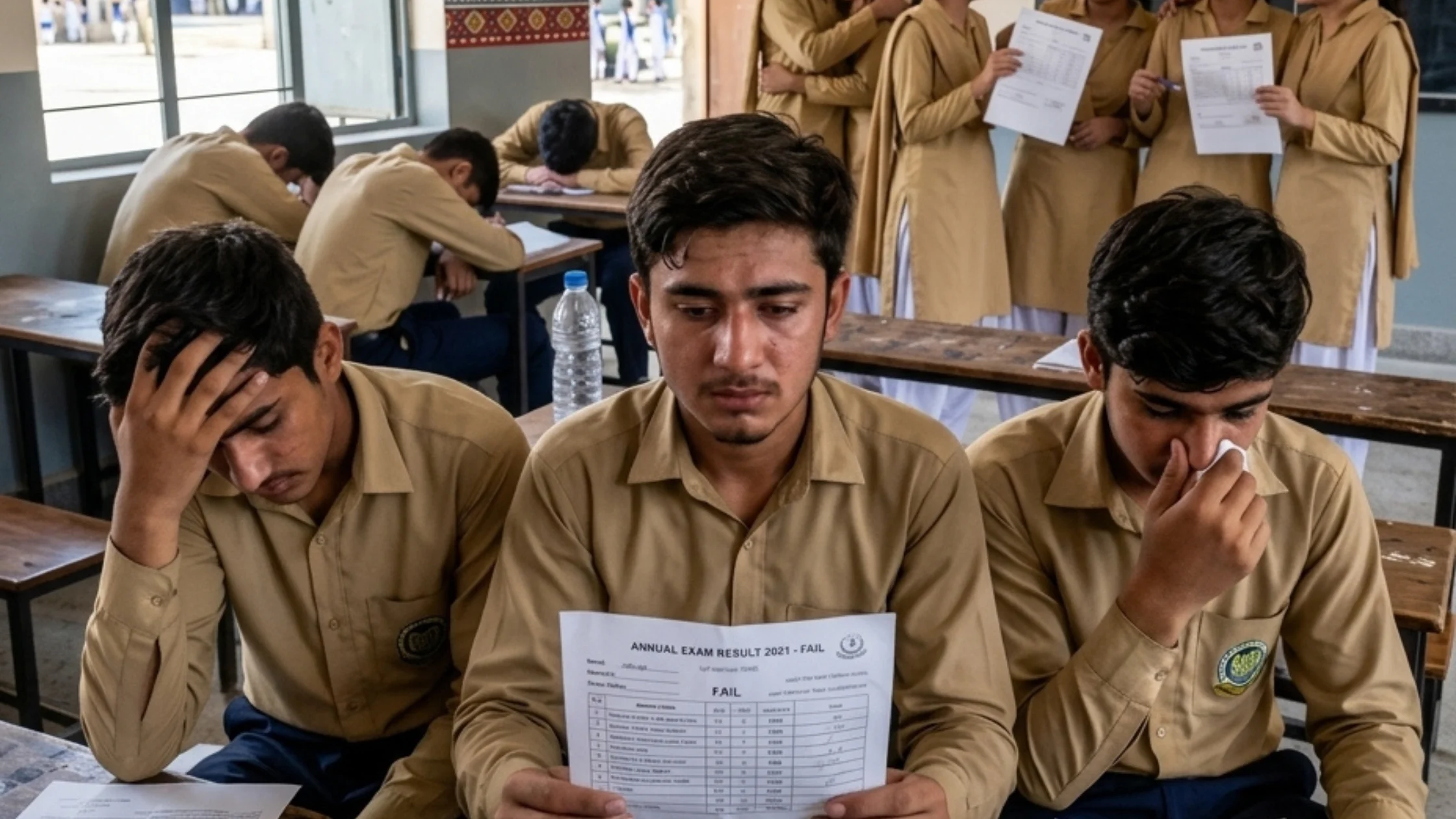
Punjab’s latest Class 9 examination results have raised serious questions about the quality of education in government schools, particularly for boys. The results show a worrying performance gap across several education boards, with some districts recording pass rates of less than half of the students.
The situation is especially concerning in Lahore, where only 39% of Class 9 students from government schools passed their examinations, meaning that around 61% failed. The gender difference is even more striking. According to the reported figures, 72% of boys studying in government schools failed, compared with 52% of girls.
These results have once again brought attention to the challenges facing Punjab’s public education system. While examination results alone cannot explain every problem inside a classroom, such low pass rates raise important questions about teaching standards, student preparation, school management and the overall quality of education being provided to children.
Government School Boys Face the Biggest Setback
The most worrying figure from the results is the performance of boys in government schools.
With 72% of boys reportedly failing, only 28% managed to pass. The situation among girls was comparatively better, although a 52% failure rate is still a serious concern.
The gap suggests that boys in government schools may be facing particular challenges that require closer attention from education authorities.
Why are so many students failing?
There may not be one simple answer. Attendance, teaching quality, parental involvement, learning resources, school facilities and students’ own academic preparation can all influence examination performance.
However, when failure rates reach such high levels across large groups of students, the issue becomes bigger than individual students.
It becomes a question about the education system itself.
Lahore Government Schools Record a 39% Pass Rate
Lahore is considered one of Punjab’s major educational centres, with a large number of schools, colleges and educational institutions.
Despite this, only 39% of students from government schools in Lahore passed the Class 9 examinations according to the reported results.
That means more than half of the students were unsuccessful.
For parents, the numbers are understandably concerning. Class 9 is an important stage in a student’s academic journey because it marks the beginning of secondary-level board examinations.
Poor performance at this stage can affect students’ confidence and may create additional pressure as they move toward Class 10.
It also raises a fundamental question: if a majority of students are unable to pass their first secondary board examination, what support are they receiving before reaching this stage?
Punjab Education Minister Rana Sikandar Hayat to Personally Teach Students in Government Schools
Several Punjab Boards Report Low Pass Rates
The problem is not limited to Lahore.
Several major educational boards across Punjab also recorded relatively low pass rates.
| Education Board | Reported Pass Rate |
|---|---|
| Bahawalpur | 38.46% |
| Sargodha | 42.61% |
| Gujranwala | 46.51% |
| Dera Ghazi Khan | 48.18% |
| Faisalabad | 51.21% |
| Multan | 52.11% |
The figures show that some boards had pass rates below 50%, while others were only slightly above that level.
Bahawalpur Board recorded the lowest reported pass rate at 38.46%, meaning that more than six out of every ten students were unsuccessful.
Sargodha followed with a pass rate of 42.61%, while Gujranwala recorded 46.51%.
These numbers suggest that the challenge is not restricted to one particular city or district.
Why Are Students Struggling?
There are several possible reasons behind poor examination performance.
One major factor could be the quality and consistency of classroom teaching. Students who do not receive sufficient academic support throughout the year can struggle when they face board examinations.
Another issue is attendance.
Regular attendance is essential for students to understand difficult subjects, ask questions and keep up with the syllabus. If students frequently miss classes, they may enter examinations without a strong understanding of basic concepts.
The availability of teachers is another important consideration.
A school may have classrooms and students, but without enough qualified and motivated teachers, the quality of learning can suffer.
Teaching Quality Under the Spotlight
The latest results are likely to increase pressure on Punjab’s education authorities to examine teaching standards in government schools.
Teachers play a central role in student performance, but they cannot be held responsible for every failure.
The education system also needs to look at teacher training, classroom sizes, curriculum design, examination preparation and school administration.
A teacher managing a very large class may struggle to give individual attention to weaker students.
Similarly, students who fall behind early in the academic year may require additional support. Without remedial classes or targeted assistance, these learning gaps can become increasingly difficult to overcome.
The Gender Gap Needs Attention
The difference between boys and girls is one of the most striking elements of the reported results.
If 72% of government-school boys failed compared with 52% of girls, it suggests that boys are experiencing significantly greater academic difficulties in the affected schools.
This should encourage education officials to examine why the gap exists.
Are boys attending school less regularly?
Are they receiving less support at home?
Are teaching methods failing to engage male students?
Are socioeconomic pressures pushing some boys toward work or other responsibilities?
These are questions that require proper research rather than assumptions.
The numbers provide a warning, but they do not by themselves explain the reasons behind the gender gap.
Exam Results Are More Than Just Numbers
A board result may appear to be a simple percentage on paper, but behind every failed result is a student.
For some children, failing Class 9 can mean repeating the year. For others, it may reduce their motivation to continue their education.
This is particularly important in areas where families already face financial difficulties.
A student who fails may eventually leave school rather than repeat the academic year.
That is why improving pass rates is not simply about making statistics look better. It is about preventing students from falling out of the education system.
Government Schools Serve Millions of Students
Government schools remain a crucial part of Punjab’s education system.
They provide education to large numbers of children, particularly families who cannot afford expensive private schools.
This makes the quality of government education extremely important.
When public schools perform poorly, the impact can extend beyond examination results. Families may feel forced to spend money on private tuition or move their children to private institutions if they can afford it.
For low-income families, those options may not be available.
As a result, improving government schools can have a direct impact on social mobility.
Private Tuition and the Education Gap
Another issue worth considering is the growing dependence on private tuition.
Students who have access to academies and private tutors may receive additional help outside school hours. Those who cannot afford such support are often left entirely dependent on classroom teaching.
This can create an educational gap.
If a government-school student does not understand a difficult mathematical concept or struggles with science, they may not have anyone at home who can provide assistance.
Schools therefore need to become places where students can receive enough academic support without having to depend heavily on paid tuition.
What Can Be Done to Improve Results?
Improving examination results will require more than simply asking students to work harder.
Schools could identify struggling students earlier in the academic year and provide additional classes before they reach the board examinations.
Teachers could also use regular assessments to identify areas where students are having difficulty.
Other measures could include:
- Better teacher training
- Regular classroom assessments
- Additional support for weak students
- Improved attendance monitoring
- Smaller class sizes where possible
- Stronger parent-teacher communication
- Better learning materials
- Extra preparation before board examinations
- Greater monitoring of schools with unusually high failure rates
The goal should not simply be to help students pass.
The goal should be to make sure they actually understand what they are being taught.
Punjab Needs to Look Beyond Pass Percentages
The latest results should encourage policymakers to look at the bigger picture.
A high pass rate does not automatically mean students are receiving a high-quality education. Similarly, a low pass rate does not necessarily mean that every teacher or every school is failing.
Authorities need to examine the underlying causes.
Which subjects have the highest failure rates?
Are certain districts consistently underperforming?
Are schools facing teacher shortages?
How many students have irregular attendance?
Do students have access to textbooks and learning materials?
Are teachers receiving enough professional training?
Answering these questions would provide a much clearer picture than looking at overall percentages alone.
A Warning for Punjab’s Education System
The reported Class 9 results should be treated as a warning.
A situation in which large numbers of government-school students fail their examinations cannot simply be dismissed as an issue of individual performance.
The education system must ask whether students are being given the tools they need to succeed.
The particularly high failure rate among boys deserves separate attention. At the same time, the 52% failure rate among girls shows that the problem is much wider than the gender gap.
Punjab has invested heavily in improving its education infrastructure, but buildings and facilities alone cannot guarantee better learning outcomes.
Students need effective teachers, regular attendance, proper academic support and an environment that encourages them to learn.
The Real Challenge Begins After the Results
Once examination results are announced, attention often shifts toward the students who achieved the highest marks.
That is understandable.
But the larger educational challenge lies with the students who failed.
What happens to them?
Will they receive another opportunity?
Will their schools identify why they struggled?
Will parents receive guidance?
Will teachers be given resources to help them?
These questions matter because today’s struggling Class 9 student could become tomorrow’s dropout.
Early intervention can make a significant difference.
Conclusion
The latest Punjab Class 9 examination results have highlighted serious concerns about academic performance in government schools. Lahore recorded a reported government-school pass rate of just 39%, while the failure rate among boys reached 72%, compared with 52% among girls.
Other boards also reported concerning figures, including Bahawalpur at 38.46%, Sargodha at 42.61%, Gujranwala at 46.51%, Dera Ghazi Khan at 48.18%, Faisalabad at 51.21% and Multan at 52.11%.
These figures should not be viewed simply as examination statistics. They point toward deeper questions about teaching quality, student attendance, academic support, school management and the overall standard of education.
The priority now should be identifying why so many students are struggling and providing practical support before they fall further behind.
Punjab’s education system cannot afford to treat these results as just another annual statistic. The students behind these numbers need attention, support and a better chance to succeed.
FAQs
1. What percentage of government-school boys failed in Lahore?
According to the reported Class 9 results, 72% of boys from government schools in Lahore failed, while 28% passed.
2. What was the government-school pass rate in Lahore?
The reported pass rate for government-school students in Lahore was 39%, meaning approximately 61% failed.
3. Which Punjab board recorded the lowest pass rate among those listed?
Among the reported figures, Bahawalpur Board recorded the lowest pass rate at 38.46%.
4. Did girls perform better than boys?
Yes. The reported figures show that 52% of girls failed, compared with 72% of boys from government schools, indicating a significant gender performance gap.
5. What do the results say about Punjab’s education system?
The results raise concerns about teaching quality, student preparation, attendance, academic support and educational standards in government schools. However, detailed analysis is needed to determine the exact reasons behind the low performance.