
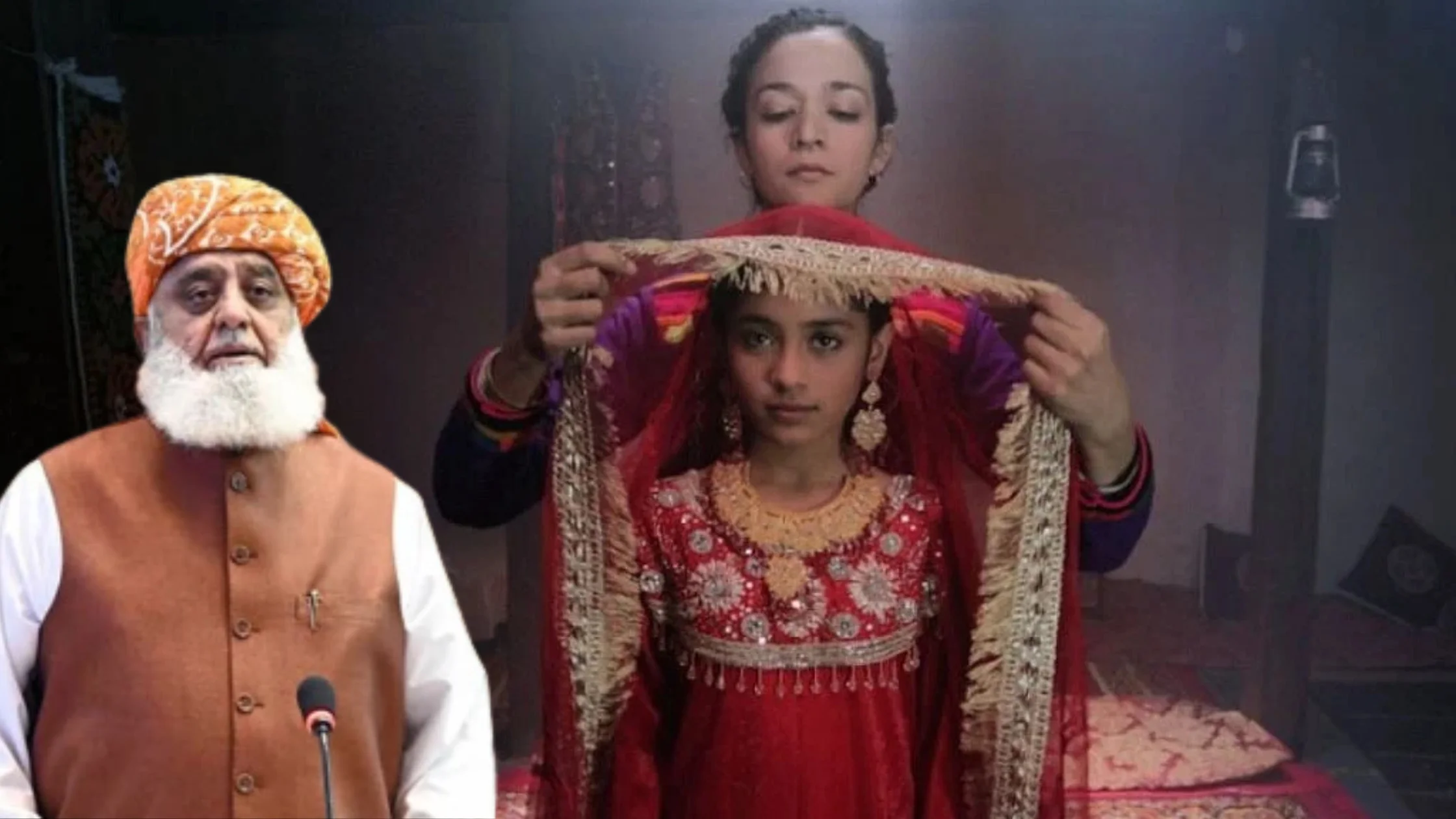
During a session of the National Assembly, Jamiat Ulema-e-Islam (F) chief Maulana Fazal-ur-Rehman delivered a pointed challenge to the state’s authority on the issue of child marriage. He declared, “I will marry off youths of 15 years, 12 years, and 10 years. You tell me how you will counter me.” This statement presents a direct confrontation to ongoing legislative and social efforts aimed at establishing and enforcing a minimum age for marriage in Pakistan.
The remark highlights a deep-seated tension between certain traditional interpretations and modern legal frameworks designed to protect minors. It brings into sharp focus the ongoing national debate surrounding child marriage, where religious and cultural norms often collide with principles of child rights, health, and safety advocated by national and international organizations.
Currently, Pakistan’s legal landscape on this issue is fragmented. Sindh province has set the minimum age for marriage at 18 through the Sindh Child Marriage Restraint Act of 2013. Other provinces, however, still operate under the older, federal Child Marriage Restraint Act of 1929, which sets the age at 16 for girls and 18 for boys. This law is widely criticized for being outdated and poorly enforced, allowing the practice to persist in many areas. There have been repeated attempts to introduce stricter, uniform federal legislation, but these efforts have often met with significant resistance from conservative quarters.
International Praise for Punjab’s Early Childhood Education Model Under CM Maryam Nawaz’s Leadership
Maulana Fazal-ur-Rehman’s challenge underscores a critical practical hurdle: the gap between law and enforcement. It questions the state’s capacity and political will to implement such regulations against influential opposition. The statement also reignites a complex theological debate. Some conservative scholars argue that Islam permits marriage after puberty, which they interpret as occurring potentially before the age of 18. Conversely, other Islamic scholars and child rights advocates emphasize the Quranic injunctions for mutual consent, maturity, and overall welfare, arguing that these concepts align with modern definitions of adulthood and the prevention of harm.
The government now faces a delicate test. It must balance respect for religious sentiments with its constitutional and international obligations to safeguard children. Potential responses could range from legislative action and stronger enforcement mechanisms to broader educational campaigns aimed at shifting public perception about the harms of child marriage, which is linked to severe health risks, truncated education for girls, and cycles of poverty.
Frequently Asked Questions
What did Maulana Fazal-ur-Rehman say?
He stated in the National Assembly that he would facilitate marriages for youths as young as 10, 12, and 15 years old, and challenged the government to counter him.
What is the legal age for marriage in Pakistan?
The law varies. Sindh province sets it at 18 for both genders. Elsewhere, the Child Marriage Restraint Act 1929 sets it at 16 for girls and 18 for boys, though this law is weakly enforced.
Why is child marriage considered harmful?
Studies link it to severe consequences, including higher risks of maternal and infant mortality, domestic violence, interrupted education for girls, economic dependency, and psychological trauma. It is recognized internationally as a violation of human rights.
How might the government respond?
The government could respond by strengthening enforcement of existing laws, pushing for clearer federal legislation, launching public awareness campaigns, and engaging in dialogue with religious scholars to find common ground that prioritizes child welfare.
What is the religious perspective on this issue?
Views vary. Some conservative scholars cite puberty as a minimum benchmark. Others argue that Islamic principles require maturity, informed consent, and the overall well-being of the individual—conditions not met in child marriages