
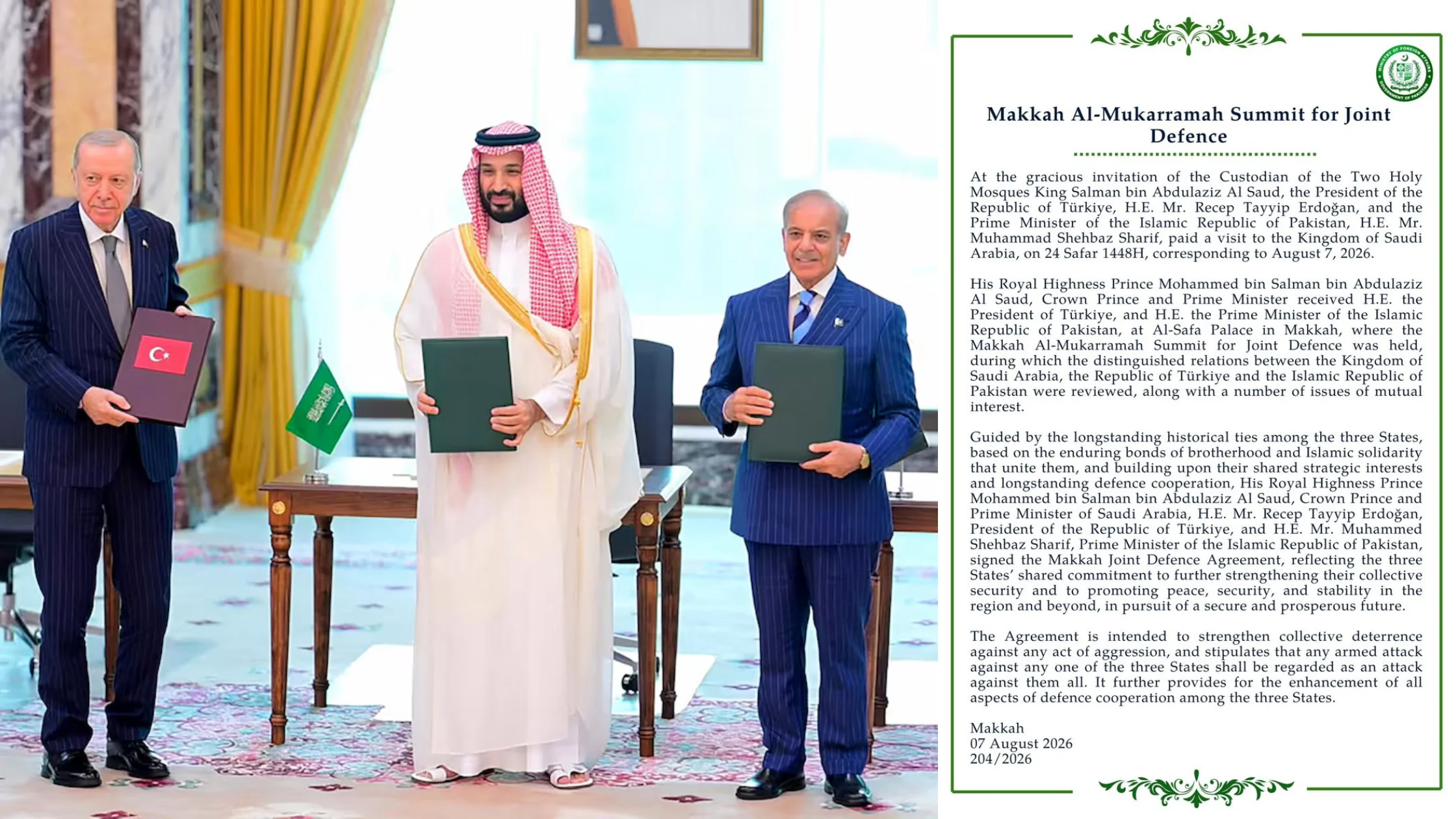
The signing of the Mecca Joint Defense Agreement by Pakistan, Saudi Arabia and Türkiye marks an important development in the security landscape of the Muslim world. The agreement brings together three countries with different but complementary strengths: Pakistan has a large and experienced military, Türkiye has a rapidly expanding defense industry and advanced military technology, while Saudi Arabia has significant financial resources and a growing defense modernization program.
The agreement was signed in Makkah Al-Mukarramah, reflecting the importance the three countries attach to their relationship. Rather than being presented as an alliance directed against a particular country, the agreement has been described as a framework for collective security, defense cooperation and regional stability.
Below is a detailed breakdown of the major elements and the significance of the partnership.
1. Pakistan’s Role in the New Security Partnership

Pakistan is one of the most important military powers involved in the agreement. Its armed forces have decades of experience in conventional warfare, counterterrorism operations, border security and military training.
Pakistan also has a significant defense-industrial base. The country produces aircraft, armored vehicles, artillery systems, small arms and other military equipment. Organizations such as Pakistan Aeronautical Complex have also developed experience in aircraft production and modernization.
Pakistan’s biggest strategic distinction is its nuclear capability. However, it is important to separate Pakistan’s existing national military capabilities from the provisions of the Mecca agreement. The agreement does not mean that Pakistan’s nuclear weapons have become a shared trilateral arsenal.
Pakistan can nevertheless bring considerable military experience to the partnership. Its armed forces regularly conduct multinational exercises and maintain extensive relationships with military institutions in both Saudi Arabia and Türkiye.
For Islamabad, deeper defense cooperation can also create opportunities for training, technology partnerships, defense exports and greater strategic coordination.
2. Saudi Arabia’s Strategic Importance

Saudi Arabia brings a very different type of strength to the partnership.
The Kingdom has substantial financial resources and has invested heavily in modernizing its armed forces. Saudi Arabia operates sophisticated aircraft, air-defense systems, armored vehicles, naval assets and other advanced military equipment sourced from several international partners.
The country is also pursuing Vision 2030, which includes efforts to develop domestic defense manufacturing and reduce dependence on foreign suppliers.
Closer cooperation with Pakistan and Türkiye could support these objectives.
Pakistan provides extensive military experience and a large pool of trained personnel, while Türkiye has developed a competitive defense industry capable of producing drones, armored vehicles, naval platforms, electronic systems and other military technologies.
Saudi Arabia therefore has the financial capacity to support large-scale defense projects, while its partnerships with Türkiye and Pakistan can provide additional technological and operational capabilities.
3. Türkiye’s Role and Defense Technology

Türkiye has become one of the most important emerging defense producers in the world.
Over the past decade, Turkish companies have developed internationally recognized unmanned aerial vehicles, armored vehicles, naval platforms, electronic warfare systems and other defense technologies.
Turkish drones, in particular, have attracted international attention because of their use in several conflicts and their growing export market.
For the new trilateral partnership, Türkiye can potentially provide expertise in areas such as unmanned systems, naval technology, armored vehicles, communications and defense manufacturing.
This is particularly significant for Saudi Arabia, which has been seeking to expand its domestic defense industry.
Pakistan also has an established relationship with Türkiye in defense production. The two countries have cooperated on naval programs and other military projects, creating an existing foundation for deeper technological collaboration.
Government Decides to Increase Defense Budget Amid Security Concerns
Pakistan Poised to Export $12.5 Billion Worth of Defense Equipment
Kuwait Approves Defense Cooperation Agreement with Pakistan
Saudi Arabia, Turkey and Pakistan Forge “Muslim-NATO” Mutual Defense Pact
4. The Mutual Defense Principle

The most important aspect of the agreement is its collective-defense concept.
The pact establishes a commitment that an armed attack against one member would be treated as an attack against all three.
This principle gives the agreement greater strategic importance than an ordinary military cooperation arrangement.
It means that the three countries are signaling that they intend to consult and coordinate more closely if one of them faces a serious external military threat.
However, the exact procedures for responding to an attack, including the nature and scale of any military response, would depend on future arrangements and circumstances.
The mutual-defense language should therefore not automatically be interpreted as meaning that all three countries would immediately deploy troops in every possible conflict.
5. Collective Military Strength

A major reason the agreement has attracted attention is the combined military potential of the three countries.
Pakistan contributes a very large standing military force and significant conventional and nuclear capabilities.
Türkiye contributes a major NATO military force with extensive operational experience, modern defense technology and a growing domestic arms industry.
Saudi Arabia contributes a highly equipped military supported by substantial financial resources and access to advanced Western weapons systems.
Together, these capabilities create a powerful combination of manpower, technology, financing and military experience.
However, figures circulating online about their combined military strength should be treated carefully. Claims such as 2 million personnel, 7,000 tanks, 90,000 armored vehicles, 34 submarines and 500 combat and naval platforms are not provisions of the agreement itself. They are aggregate estimates or social-media calculations and should not be presented as official figures contained in the pact.
6. The Nuclear Dimension
One of the most widely circulated claims surrounding the agreement is that the three countries collectively represent 170 nuclear warheads.
This requires important clarification.
Pakistan is a nuclear-armed state. Saudi Arabia and Türkiye are not recognized nuclear-weapon states under the Nuclear Non-Proliferation Treaty.
Therefore, Pakistan’s nuclear weapons remain under Pakistan’s own national command and control. Signing a defense agreement with Saudi Arabia and Türkiye does not automatically transfer Pakistan’s nuclear arsenal to a trilateral command.
The nuclear capability nevertheless adds another strategic dimension to the partnership because Pakistan’s nuclear deterrence contributes to its overall national security posture.
Any discussion of the agreement’s nuclear significance should therefore distinguish between Pakistan’s independent nuclear capability and the collective defense framework created by the three countries.
7. The Economic Strength Behind the Partnership

Another frequently repeated figure is a combined economic size of around $3 trillion.
The three economies collectively represent substantial economic resources, but the exact figure depends on whether GDP is measured using nominal exchange rates or purchasing power parity.
Saudi Arabia is one of the world’s largest oil-producing economies and possesses enormous energy and investment resources.
Türkiye has a diversified industrial economy with major manufacturing, construction, defense, automotive and tourism sectors.
Pakistan has a large population, a major agricultural base, growing services and technology sectors, and an expanding industrial economy.
The combination creates opportunities beyond military cooperation. Defense production, infrastructure, energy, trade and investment could all become areas of greater collaboration.
8. Defense Industry Cooperation

One of the most important long-term possibilities is greater cooperation between the defense industries of the three countries.
Türkiye has increasingly emphasized domestic defense production.
Pakistan already manufactures a range of military equipment and has experience developing aircraft and naval platforms.
Saudi Arabia is seeking to localize a much greater share of its defense production under Vision 2030.
This creates a natural opportunity for cooperation.
Instead of simply buying weapons from foreign suppliers, the three countries could potentially collaborate on the development, manufacturing and maintenance of military equipment.
Such cooperation could eventually include drones, armored vehicles, naval systems, ammunition, electronic systems and other technologies.
9. Saudi Money, Turkish Technology and Pakistani Military Experience

The phrase “Saudi money + Turkish technology + Pakistani military power” has become popular in social-media discussions about the agreement.
Although this is a simplified description, it captures one of the partnership’s most interesting possibilities.
Saudi Arabia has the financial capacity to support large defense and infrastructure projects.
Türkiye has developed a strong domestic defense industry and increasingly sophisticated military technologies.
Pakistan has a large military establishment, operational experience and its own defense-production capabilities.
If these strengths are effectively combined, the partnership could move beyond military exercises and become a broader defense-industrial relationship.
However, the success of such cooperation would depend on actual projects, funding, technology-transfer agreements and long-term political commitment.
10. The Importance of Joint Military Training
Military cooperation between Pakistan, Saudi Arabia and Türkiye is not entirely new.
The three countries have maintained different forms of defense and military relationships for years.
The new agreement could provide a framework for expanding joint exercises and training programs.
These exercises can improve communication between armed forces, develop interoperability and allow military personnel to learn from each other’s operational experience.
Training can also cover areas such as counterterrorism, maritime security, air defense, disaster response and military logistics.
Over time, repeated joint exercises can make cooperation more effective during an actual regional crisis.
11. Air Power and Future Fighter Aircraft
Social media discussions surrounding the agreement have also mentioned F-35 fighter aircraft for Saudi Arabia and Türkiye.
This claim should not be treated as a confirmed element of the Mecca agreement.
The agreement itself does not establish a trilateral F-35 fleet.
The United States’ F-35 program is a separate issue involving individual countries, American export policy and complex defense agreements.
Türkiye was originally a participant in the F-35 program but was removed from the program following its acquisition of Russia’s S-400 air-defense system.
Saudi Arabia, meanwhile, has expressed interest in acquiring advanced fighter aircraft, but any potential F-35 sale would depend on separate decisions by the United States.
Therefore, claims that the Mecca agreement automatically brings F-35 aircraft into the trilateral military structure are not supported by the agreement itself.
12. Naval Cooperation
The three countries also have significant maritime interests.
Saudi Arabia has coastlines on both the Red Sea and the Arabian Gulf.
Pakistan has access to the Arabian Sea and operates an important naval force.
Türkiye controls access between the Black Sea and Mediterranean through the Turkish Straits and has developed a growing domestic naval industry.
This geographic diversity creates potential opportunities for cooperation in maritime security, naval training, anti-piracy operations and protection of important sea routes.
Türkiye’s growing naval manufacturing capabilities could also create opportunities for future defense-industrial cooperation with Pakistan and Saudi Arabia.
13. Counterterrorism and Regional Security
Counterterrorism is another area where cooperation could be particularly valuable.
Pakistan has extensive experience fighting militant organizations and conducting counterterrorism operations.
Türkiye has also faced serious terrorism and security challenges and has developed significant counterterrorism capabilities.
Saudi Arabia has invested heavily in counterterrorism, intelligence and internal security.
Closer intelligence sharing and training could therefore help the three countries address transnational security threats.
The partnership could also contribute to cooperation against organized crime, terrorism financing and other cross-border threats.
14. Why the Agreement Was Signed in Makkah
The location of the signing is highly significant.
Makkah is Islam’s holiest city and holds enormous religious importance for Muslims around the world.
Holding the ceremony at Al-Safa Palace in Makkah Al-Mukarramah gives the agreement a strong symbolic dimension.
Pakistan, Saudi Arabia and Türkiye all have significant influence across the Muslim world, although their foreign-policy priorities are not identical.
The Makkah setting therefore emphasizes the historical, cultural and religious connections among the three countries while the agreement itself focuses on security and defense cooperation.
15. Possible Impact on Iran
Iran is likely to pay close attention to the development because Saudi Arabia, Türkiye and Pakistan all have important relationships with Tehran.
However, it would be inaccurate to automatically describe the agreement as an anti-Iran alliance.
Saudi Arabia and Iran have made efforts in recent years to improve diplomatic relations, while Pakistan shares a long border with Iran and has repeatedly emphasized the importance of peaceful relations with its neighbors.
Türkiye also maintains complex political, economic and security relations with Iran.
The trilateral agreement could therefore affect regional calculations without necessarily becoming a direct confrontation with Tehran.
16. Impact on the Middle East
The agreement could become an important factor in the changing security architecture of the Middle East.
For years, regional security has largely depended on relationships involving the United States, Gulf countries, Türkiye, Iran and other major powers.
The emergence of stronger cooperation between Saudi Arabia, Pakistan and Türkiye adds another layer to this system.
If the three countries deepen their defense relationship, they could become a more coordinated voice on issues involving regional security, terrorism, maritime routes and military technology.
17. What It Means for Pakistan
For Pakistan, the agreement offers several potential strategic advantages.
It strengthens relations with two important partners and creates opportunities for expanded defense cooperation.
Saudi investment could potentially support Pakistan’s economy, energy sector and defense industry, while Turkish cooperation could provide access to advanced military technology and joint-production opportunities.
Pakistan could also benefit diplomatically from closer coordination with Riyadh and Ankara.
At the same time, Islamabad would need to maintain careful relations with other major powers and neighboring countries.
18. What It Means for Saudi Arabia
For Saudi Arabia, the agreement provides another layer of security cooperation beyond its existing partnerships.
The Kingdom has traditionally relied heavily on Western military suppliers, particularly the United States.
Closer relations with Pakistan and Türkiye could diversify its strategic partnerships.
It could also help Saudi Arabia develop domestic defense capabilities by working with Türkiye and Pakistan on technology, manufacturing and training.
19. What It Means for Türkiye
Türkiye already has a major military role within NATO and possesses one of the region’s strongest indigenous defense industries.
The agreement gives Ankara another platform for expanding its strategic relationship with the Gulf and South Asia.
Saudi investment could support Turkish defense companies and joint projects, while cooperation with Pakistan could strengthen Ankara’s existing military partnerships in South Asia.
For Türkiye, the agreement could therefore provide both strategic and economic opportunities.
20. A Partnership With Long-Term Potential
The real importance of the Mecca Joint Defense Agreement will ultimately depend on what happens after the signing ceremony.
A treaty by itself does not create military power overnight.
Its significance will be determined by whether the three countries establish permanent mechanisms for joint planning, intelligence sharing, exercises, defense production, technology cooperation and crisis coordination.
If those mechanisms develop successfully, the agreement could become one of the most important examples of trilateral defense cooperation among Muslim-majority countries.
Conclusion
The Mecca Joint Defense Agreement brings Pakistan, Saudi Arabia and Türkiye into a new framework for collective security and closer military cooperation.
Pakistan contributes military experience and defense capabilities, Türkiye brings advanced and increasingly independent defense technology, while Saudi Arabia offers financial strength and a major modernization program.
The partnership therefore has the potential to become much more than a symbolic agreement.
At the same time, claims circulating online about 170 nuclear warheads, 1,000 fighter jets, 7,000 tanks, 34 submarines, 500 military platforms and an immediate F-35 capability should not be presented as official provisions of the agreement. These are separate estimates or claims and require independent verification.
The true test will be implementation. If Pakistan, Saudi Arabia and Türkiye transform the agreement into practical military exercises, joint defense projects, intelligence cooperation and technology partnerships, the Makkah pact could mark the beginning of a significant new security framework stretching from South Asia to the Middle East and the Mediterranean.