

The arrival of Prince Rahim Aga Khan V in Pakistan marks a moment of profound spiritual, cultural, and national significance for the nation. From May 20 to May 26, 2026, His Highness is undertaking his first official visit to Pakistan since assuming the leadership of the Shia Ismaili Muslim community as the 50th Imam in February 2025, following the passing of his revered father, His Late Highness Prince Karim Aga Khan IV. This momentous occasion has been met with widespread anticipation and elaborate preparations, particularly in the northern regions of Gilgit-Baltistan and Chitral, home to a significant Ismaili population.
Upon his arrival at Noor Khan Airbase in Islamabad on Wednesday, May 20, Prince Rahim Aga Khan V received a state welcome, personally greeted by President Asif Ali Zardari, accompanied by First Lady Aseefa Bhutto Zardari. Children in traditional attire presented flowers, setting a warm and celebratory tone for the week-long visit. This reception underscores the deep and enduring relationship between Pakistan and the Ismaili Imamat, a bond rooted in shared commitments to development, pluralism, education, and human progress. The visit is widely seen as a renewal of this partnership, touching upon critical areas of national importance and reaffirming the Aga Khan Development Network’s (AKDN) steadfast commitment to Pakistan’s welfare and development.
Strengthening Bonds: Official Meetings and Development Commitments
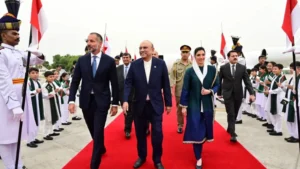
The official itinerary of Prince Rahim Aga Khan V’s visit to Pakistan commenced with a series of high-level engagements, reflecting the strong diplomatic and developmental ties between the Ismaili Imamat and the Pakistani state. Immediately following his arrival, Prince Rahim proceeded to the Aiwan-i-Sadr (President House), where he was accorded a formal tri-services guard of honour, with contingents from the Pakistan Army, Navy, and Air Force participating. The national anthem was played, further highlighting the state guest status accorded to the spiritual leader.
Key Official Engagements

- Meeting with President Asif Ali Zardari: Prince Rahim Aga Khan V held a detailed meeting with President Asif Ali Zardari, which was also attended by First Lady Aseefa Bhutto Zardari and Pakistan Peoples Party (PPP) Chairman Bilawal Bhutto Zardari. During these discussions, President Zardari lauded the Aga Khan Development Network’s (AKDN) extensive and long-standing contributions to Pakistan. He specifically acknowledged AKDN’s pivotal work in crucial sectors such as healthcare, education, community development, climate resilience, and heritage conservation. The President reiterated Pakistan’s commitment to further strengthening cooperation with AKDN for the welfare and development of vulnerable communities across the country. In response, Prince Rahim Aga Khan V expressed his gratitude for the warm welcome and reaffirmed AKDN’s continued dedication to supporting humanitarian and development initiatives in Pakistan.

- Prime Minister Shehbaz Sharif Reaffirms Pakistan’s Defence Resolve During Visit to Command & Staff College Quetta
- Tayyip Erdogan in Pakistan: A Historic Moment in Pak-Turkey Relations
- https://www.instagram.com/reel/DYmEl10NNL6/?utm_source=ig_web_copy_link&igsh=MzRlODBiNWFlZA==
- Delegation-Level Talks: Following the initial meeting, delegation-level talks were held. Prince Rahim’s delegation included key AKDN figures such as Sultan Ali Allana, Director of the Aga Khan Fund for Economic Development and Head of Financial Services at AKDN; Shafik Sachedina, Head of the Department of Jamati Institutions; Nizar Noor Mohammed Mewawala, President of the Ismaili Council for Pakistan; and Akbar Ladak, Vice President of the Ismaili Council for Pakistan. These talks likely delved into specific areas of collaboration and future projects.
- Presidential Banquet: President Zardari hosted a grand banquet in Prince Rahim’s honour, attended by a host of high-ranking Pakistani officials. Notable attendees included Prime Minister Shehbaz Sharif, Chief of Defence Forces and Chief of the Army Staff Field Marshal Asim Munir, Deputy Prime Minister and Foreign Minister Ishaq Dar, Chairman Senate Syed Yousuf Raza Gilani, Speaker National Assembly Sardar Ayaz Sadiq, Chief Minister Sindh Syed Murad Ali Shah, federal ministers, members of parliament, and members of the diplomatic community. This gathering underscored the broad governmental appreciation for the Aga Khan family’s contributions to Pakistan.
- Meeting with Prime Minister Shehbaz Sharif: On Thursday, Prime Minister Shehbaz Sharif hosted Prince Rahim Aga Khan V for a breakfast meeting. The Prime Minister warmly welcomed His Highness and appreciated his commitment to fostering peace, stability, and constructive engagement. He highlighted the longstanding partnership between Pakistan and AKDN, commending its impactful work in rural development, healthcare, education, disaster resilience, climate adaptation, renewable energy, digital skills training, and youth entrepreneurship. Prime Minister Sharif specifically urged AKDN to deepen and expand its partnership with Pakistan, particularly in Gilgit-Baltistan and Chitral, where its institutional presence and community outreach are highly valued. He also welcomed enhanced engagement with the Aga Khan University (AKU) and noted Prince Rahim’s advocacy for environmental stewardship, emphasizing AKDN as a natural and trusted partner in Pakistan’s efforts to strengthen climate resilience, especially in glacially vulnerable northern areas. The Prime Minister also thanked Prince Rahim for making the Serena Hotel available on a gratis basis for the Islamabad Talks between Iran and the United States in April 2026.



AKDN’s Enduring Contributions to Pakistan
The Aga Khan Development Network has a remarkable history of engagement in Pakistan, spanning over 110 years, with its first non-profit school established in Gwadar, Baluchistan, in 1905. The network operates through various agencies, complementing government efforts and receiving numerous national and international awards for its successful programmes.
The AKDN’s integrated development approach focuses on improving the quality of life for marginalized communities, leveraging the capabilities of multiple agencies across key sectors. Our collective experience with AKDN’s work showcases its significant impact:
- Healthcare: AKDN operates an array of medical facilities, including the renowned Aga Khan University (AKU) in Karachi, providing quality healthcare services to millions across Pakistan annually. Initiatives include maternal and child health programs, vaccinations, nutrition awareness, and training community health workers, particularly in remote areas like Gilgit-Baltistan and Chitral.
- Education: Through the 156 schools of the Aga Khan Education Services (AKES) and teacher training programs by AKU and the Aga Khan Foundation (AKF), AKDN has reached tens of thousands of teachers and millions of students, producing thousands of doctors, nurses, and midwives.
- Community Development & Livelihoods: The Aga Khan Rural Support Programme (AKRSP), established in 1982, is a cornerstone of AKDN’s efforts in rural development, leading integrated, innovative, and gender-sensitive programmes in Gilgit-Baltistan, Khyber Pakhtunkhwa, and Sindh. AKDN provides financial services to millions of Pakistanis and has fostered disaster resilience through community emergency response teams and trained volunteers.
- Climate Resilience & Environment: Recognizing Pakistan’s vulnerability to climate change, especially in its northern regions, AKDN has planted over 39 million trees, built smoke-free stoves to reduce fuelwood consumption by 50%, and provides electricity to approximately 40,000 households through 333 micro-hydroelectric projects. This focus aligns perfectly with Prince Rahim’s advocacy for environmental stewardship.
- Heritage Conservation: The Aga Khan Trust for Culture (AKTC) has been instrumental in revitalizing Pakistan’s rich heritage, restoring over 170 historic settlements, forts, monuments, buildings, and spaces, from the Lahore Fort to the Khaplu Village and Palace in Baltistan.
The ongoing commitments reaffirmed during Prince Rahim’s visit underscore AKDN’s dedication to creating a critical mass of integrated development activities that not only raise income but also lead to a broad, sustained improvement in the overall quality of life, encouraging self-reliance and a long-term view of development.
A Spiritual Journey to Gilgit-Baltistan and Chitral

Beyond the official engagements in Islamabad, the visit of Prince Rahim Aga Khan V to Pakistan carries an exceptionally deep spiritual and emotional resonance, particularly for the vibrant Ismaili communities nestled in the majestic northern regions of Gilgit-Baltistan (GB) and Chitral. For the Ismaili Jamat, a gathering with their spiritual leader, known as a “Deedar,” is a moment of profound spiritual connection, reflection, and renewal.
Anticipation and Preparations
The anticipation for His Highness’s arrival in these mountainous regions has been palpable, described as a “historic and emotional moment”. Preparations reached an extraordinary scale, with federal and regional resources mobilized to ensure a grand welcome. Across Passu, Hunza, Gilgit, Gahkuch, Taus, and multiple locations in Chitral, entire valleys have been transformed into expressions of love and loyalty. Mountainsides are adorned with welcome messages, and beautifully constructed welcome gates, decorated with expressions of gratitude, unity, and allegiance, stand as powerful testaments to the community’s enduring bond with its spiritual leadership.
Local authorities have made extensive arrangements for security, logistics, and crowd management, including considering multiple sessions at some venues to manage the expected large gatherings. Special arrangements are also being made for the transportation of individuals with special needs to the “Didargahs” (places of gathering).
Scheduled Engagements in the Northern Areas
Prince Rahim Aga Khan V’s itinerary in Gilgit-Baltistan and Chitral is set to be comprehensive, allowing him to interact with his followers and review the ongoing development works under the Aga Khan Development Network. The planned schedule for the “Didar” includes:
- May 21 afternoon: Taus, Gupis
- May 22 morning: Passu Hunza
- May 22 afternoon: Gahkuch
- May 23 morning: Parwak Lasht, Upper Chitral
- May 23 afternoon: Taus Gupis (second session)
- May 24 morning: Gilgit
- May 24 afternoon: Gahkuch (second session)
- May 25 morning: Parwak (Upper Chitral) (second session)
- May 25 afternoon: Garam Chashma (Lower Chitral)
These engagements underscore the spiritual connection and direct interaction that the Ismaili community cherishes with their Imam. For many, this is not merely a visit but a moment of deep connection, affirmation of identity, and renewal of faith, especially as Prince Rahim assumes his role as the 50th Imam.
Impact on Local Communities and AKDN’s Work
The northern regions of Gilgit-Baltistan and Chitral have long been beneficiaries of AKDN’s integrated development initiatives. The visit highlights the continuing importance of long-term investment in these remote and often underserved mountain regions. AKDN agencies have been particularly active in:
- Disaster Preparedness and Climate Resilience: These areas face growing climate and disaster risks, including glacial lake outburst floods and landslides. AKDN has implemented programs to build community resilience and provide critical support.
- Rural Development: The Aga Khan Rural Support Programme (AKRSP) has been a transformative force, empowering communities to take charge of their futures through sustainable and inclusive development models.
- Healthcare and Education: Despite challenges like limited road access and healthcare gaps, AKDN has significantly improved healthcare delivery and educational opportunities, with initiatives like telemedicine connecting remote areas to specialists.
The spirit of unity and harmony in Gilgit-Baltistan and Chitral, where diverse religious and cultural communities coexist peacefully, is also a remarkable aspect of these regions. Leaders and representatives of sister communities have warmly extended their support in welcoming His Highness, demonstrating an extraordinary model of interfaith harmony and mutual respect. As a direct descendant of Hazrat Ali (AS), Prince Rahim Aga Khan V’s visit carries both spiritual and historical resonance for the people of these mountainous regions.
Frequently Asked Questions (FAQ)
We understand that a visit of this magnitude generates many questions. Here, we address some common inquiries regarding Prince Rahim Aga Khan V’s historic visit to Pakistan.
Q1: Who is Prince Rahim Aga Khan V?
A1: Prince Rahim Aga Khan V is the 50th and current hereditary Imam (spiritual leader) of the Shia Imami Ismaili Muslims. He formally assumed this role in February 2025, following the passing of his father, His Late Highness Prince Karim Aga Khan IV. He also serves as the Chairman of the Aga Khan Development Network (AKDN).
Q2: What is the significance of this visit to Pakistan?
A2: This is Prince Rahim Aga Khan V’s first official visit to Pakistan since becoming the 50th Imam, making it a historic and deeply significant event. It reinforces the longstanding partnership between Pakistan and the Ismaili Imamat, and the Aga Khan Development Network’s (AKDN) continued commitment to the country’s development and humanitarian initiatives. For the Ismaili community, particularly in Gilgit-Baltistan and Chitral, it is a moment of profound spiritual connection and renewal.
Q3: What is the Aga Khan Development Network (AKDN)?
A3: The Aga Khan Development Network (AKDN) is a group of private, international, non-denominational development agencies founded by the Aga Khan. It works to improve living conditions and opportunities for people in over 30 countries, including Pakistan, across a wide range of sectors such as health, education, culture, rural development, climate resilience, and economic development.
Q4: What are the key areas of AKDN’s work in Pakistan?
A4: In Pakistan, AKDN has a presence for over 110 years. Its key areas of work include healthcare (e.g., Aga Khan University), education (e.g., Aga Khan Education Services), community development (e.g., Aga Khan Rural Support Programme), climate resilience, heritage conservation, microfinance, and early childhood development.
Q5: What is “Deedar” and why is it important during the visit to Gilgit-Baltistan and Chitral?
A5: In Ismaili tradition, “Deedar” refers to a spiritual gathering or audience with their Imam. It is a moment of deep spiritual connection, reflection, and renewal for the Ismaili Jamat. Prince Rahim’s “Deedar” in Gilgit-Baltistan and Chitral allows him to directly engage with his followers in these remote regions, which holds immense religious and cultural significance for them.
Conclusion: A Future of Shared Vision and Enduring Partnership
The historic visit of Prince Rahim Aga Khan V to Pakistan, from May 20 to May 26, 2026, has undeniably reinforced the deep-rooted and multifaceted partnership between the Ismaili Imamat and the Republic of Pakistan. As his first official tour to the country since assuming the mantle of the 50th Imam, it has been a journey marked by significant diplomatic engagements, a reaffirmation of enduring development commitments, and profound spiritual connection with his community.
From the moment of his ceremonial welcome by President Asif Ali Zardari in Islamabad, through high-level meetings with Prime Minister Shehbaz Sharif and other key dignitaries, Prince Rahim Aga Khan V has consistently underscored the Aga Khan Development Network’s (AKDN) unwavering dedication to Pakistan’s progress. These discussions have highlighted AKDN’s crucial contributions across vital sectors such as healthcare, education, climate resilience, community development, and heritage conservation, all geared towards improving the quality of life for vulnerable communities. We have seen a mutual commitment to deepening this collaboration, particularly in the northern regions where AKDN’s impact is most pronounced.
The spiritual journey to Gilgit-Baltistan and Chitral stands as a testament to the powerful bond between the Imam and his followers. The elaborate preparations and the fervent anticipation for the “Deedar” in various locations reflect the deep reverence and spiritual significance of this visit for the Ismaili Jamat. This direct engagement with communities, coupled with reviews of AKDN’s on-ground projects, reinforces a model of development that prioritizes self-reliance, local empowerment, and sustainable progress.
As Prince Rahim Aga Khan V concludes his visit, the message is clear: the partnership between Pakistan and the Aga Khan Development Network is poised for continued growth and innovation. The focus on climate resilience, education, and holistic community development remains paramount, addressing contemporary challenges with a forward-looking vision. This historic visit not only celebrates a legacy of shared values but also lays the groundwork for a future of enhanced cooperation, mutual respect, and collective prosperity for all Pakistanis.