
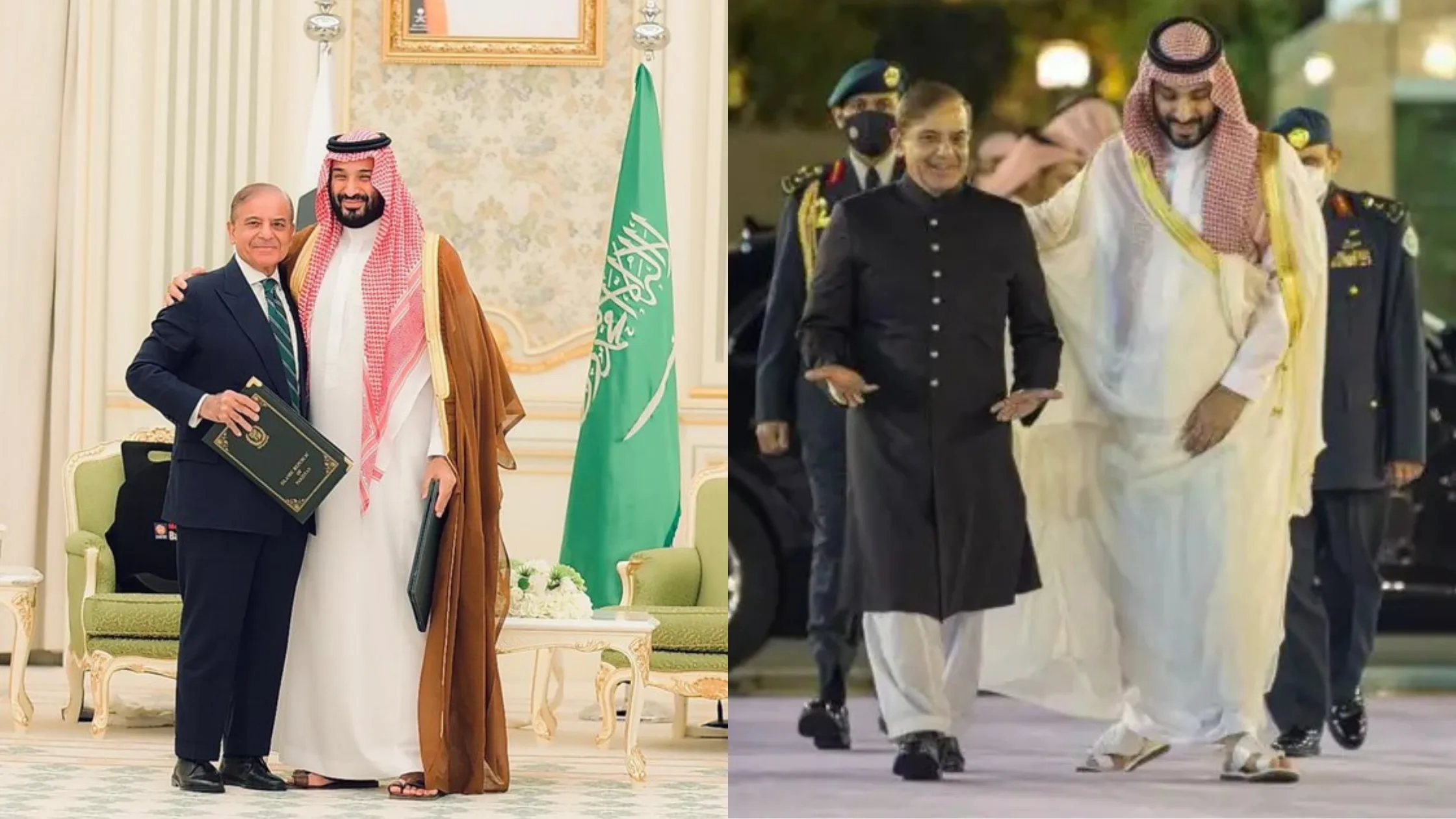
When Prime Minister Shehbaz Sharif arrived in Saudi Arabia on his recent visit, the welcome was different from the past. His plane was escorted by Saudi fighter jets, a red carpet was rolled out, and he was received with full royal protocol.
Against this backdrop, Pakistan and Saudi Arabia signed a “mutual strategic defense agreement”, declaring that any aggression against one country would be considered aggression against both.
Although the operational details of the deal remain undisclosed, photos of Prime Minister Sharif and Crown Prince Mohammed bin Salman holding copies of the pact and embracing were widely publicized.
Pakistan’s Defense Pact with Saudi Arabia Open to Other Arab Nations: Khawaja Asif
This development came just days after Israel struck a Hamas leadership building in Doha, Qatar, despite Qatar’s role as a mediator in hostage exchanges and ceasefire efforts. Qatar also hosts the largest U.S. military base in the Middle East but received no U.S. protection during the Israeli strike.
Saudi Arabia, like Qatar, heavily relies on U.S. defense support and remains one of Washington’s biggest arms buyers. The question arises: Why did Riyadh still feel the need for a defense pact with Pakistan, despite its modern arsenal and U.S. backing?
Saudi Arabia’s Military Strength in Numbers
According to Global Firepower, Saudi Arabia’s armed forces include about 407,000 personnel, of which 257,000 are active soldiers. The army has 75,000 troops, the air force around 20,000, and the navy about 13,500.
- Air Force: 917 aircraft (642 operational), including 283 fighter jets and 81 attack aircraft.
- Tanks: 840 total, with 588 ready for deployment.
- Artillery: 332 self-propelled guns and 467 towed artillery units.
- Rocket Systems (MLRS): 321 units, with 225 active.
This places Saudi Arabia among the top 20 global military powers in terms of hardware.
Why Doubts About Its True Strength?
Despite huge spending, experts say Saudi Arabia’s forces have underperformed. Professor Mehran Kamrava of Georgetown University notes that Riyadh’s army failed to achieve its goals in Yemen (2015), raising doubts about its operational capability.
He argues that nepotism weakens the military: many commanders are appointed based on family ties and loyalty to the royal family, not merit.
Comparing Saudi Arabia to Israel
Kamrava stresses that Israel’s military edge is unmatched, thanks to unconditional U.S. support, cutting-edge weapons, and a strong reserve force of “citizen soldiers.” He adds that Saudi Arabia cannot be compared to Israel on equal terms.
However, Riyadh has been quietly developing a local missile program, which could improve its long-term deterrence, similar to Iran’s advances.
Why Turn to Pakistan?
Experts suggest three main reasons:
- Diversification of alliances: Riyadh wants to reduce its dependence on the U.S. for security.
- Pakistan’s military reputation: Pakistan is a nuclear power with one of the world’s largest armies.
- Symbolism: The pact signals to Washington that Riyadh has other defense options.
Kamrava adds that recent events, such as the Israeli strike in Doha, convinced Gulf states that U.S. protection cannot be fully relied upon.
Could Others Follow?
Analysts believe similar defense pacts may emerge between other GCC states and Pakistan, or even with European and Asian powers such as China, Turkey, or South Korea.
For now, the Saudi-Pakistan defense deal reflects Riyadh’s strategy of strengthening ties with trusted partners — while reminding the U.S. that its security “umbrella” is no longer the only choice.