
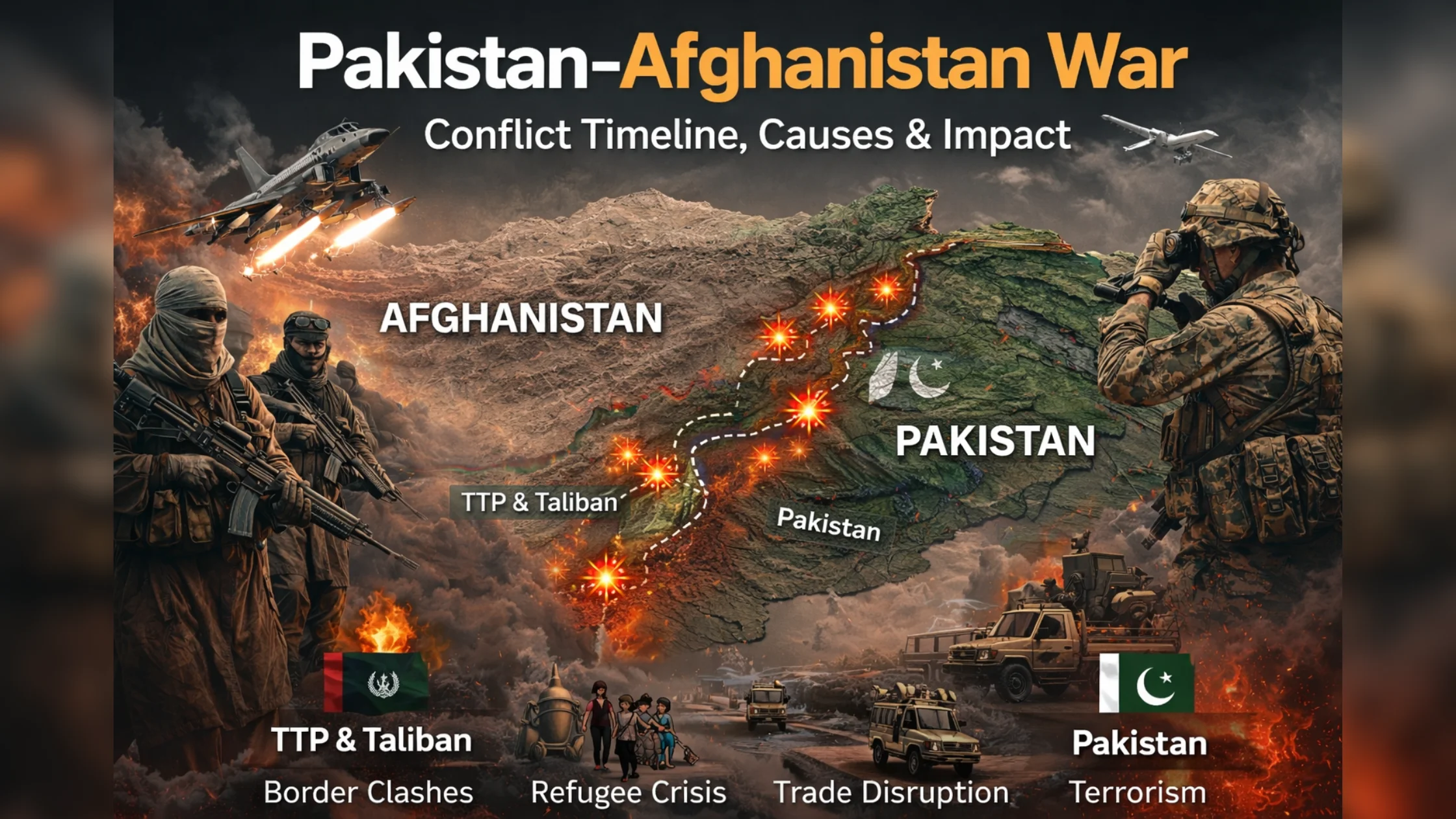
The Pakistan–Afghanistan war has become one of the most serious security crises in South Asia in recent years. Since 2024, tensions between Pakistan and Afghanistan have increased due to border clashes, militant attacks, and military operations near the Durand Line. These incidents have led to airstrikes, artillery exchanges, and security operations on both sides of the border.
The conflict is not only about territorial disputes but also about militancy, security concerns, and political tensions between the two neighboring countries. Understanding the Pakistan–Afghanistan conflict is important because it affects regional stability, international security, and the lives of millions of people living along the border.
Background of Pakistan–Afghanistan Relations
Pakistan and Afghanistan share a long and complicated history. The two countries share a border that stretches over 2,600 kilometers, known as the Durand Line. This border was drawn during the British colonial period in 1893.
Pakistan recognizes the Durand Line as the official international border, but many Afghan governments have questioned its legitimacy. This disagreement has caused tensions between the two countries for decades.
After the Taliban returned to power in Afghanistan in 2021, relations between Pakistan and Afghanistan changed significantly. Pakistan initially hoped the new Afghan government would help reduce militant activity along the border. However, violence and attacks in Pakistan continued, leading to accusations that militant groups were operating from Afghan territory.
Role of Militant Groups in the Pakistan–Afghanistan War
One of the main reasons behind the Pakistan–Afghanistan war is the presence of militant groups near the border.
The most important group in this conflict is Tehreek-e-Taliban Pakistan (TTP). This organization was formed in 2007 and has carried out numerous attacks inside Pakistan. Its goal is to establish a government based on its interpretation of Islamic law.
Pakistan claims that many TTP fighters operate from bases in Afghanistan. According to Pakistani officials, these militants cross the border to carry out attacks on Pakistani security forces and civilians.
The Afghan Taliban government has repeatedly denied these accusations. Afghan authorities say they do not support militant attacks against Pakistan.
This disagreement has increased tensions between the two countries and contributed to the escalation of violence.
China’s Wang Yi Discusses Iran Tensions and Pakistan-Afghanistan Clashes with Ishaq Dar
Beginning of the Pakistan–Afghanistan Border Clashes
The modern phase of the Pakistan–Afghanistan conflict began to intensify in 2024. During this period, several attacks occurred along the border.
One of the early incidents involved militant attacks on Pakistani military posts near the border. Pakistan accused militants based in Afghanistan of carrying out these attacks.
In response, Pakistan launched airstrikes in eastern Afghanistan, targeting suspected militant hideouts. Afghan authorities condemned these attacks and said they violated Afghan sovereignty.
These incidents marked the beginning of a series of cross-border military confrontations between the two countries.
Escalation of Fighting in 2025
The Pakistan–Afghanistan war escalated in 2025, with more frequent clashes and larger military operations.
Several major incidents occurred during this period:
- Cross-border artillery exchanges
- Airstrikes targeting militant camps
- Attacks on military checkpoints
- Drone strikes near the border
In October 2025, heavy fighting broke out after Pakistan launched airstrikes against suspected militant targets in Afghanistan. Afghan forces responded by attacking Pakistani border positions.
The fighting spread across several areas near the border and caused casualties among soldiers and civilians.
International mediators later helped negotiate a temporary ceasefire between the two countries. However, the ceasefire did not completely stop the violence.
Renewed Conflict and War in 2026
In early 2026, the situation became even more serious. Pakistan conducted new airstrikes targeting militant camps inside Afghanistan.
According to Pakistani officials, the strikes were aimed at preventing militant attacks inside Pakistan. Afghan authorities condemned the operation and accused Pakistan of violating international law.
Following these strikes, border clashes intensified, and both sides deployed additional troops along the frontier.
Military analysts began referring to the situation as a Pakistan–Afghanistan war, because of the scale of the fighting and the involvement of regular military forces from both countries.
Impact of the Pakistan–Afghanistan War
The Pakistan–Afghanistan conflict has affected several areas including security, economy, and humanitarian conditions.
Security Challenges
The war has increased instability in the region. Border areas have become dangerous due to frequent shelling, gunfire, and militant activity.
Security forces from both countries remain on high alert, and military operations continue in several districts.
Civilian Displacement
Many civilians living near the border have been forced to leave their homes. Villages located near conflict zones face constant danger from artillery fire and airstrikes.
Humanitarian organizations have expressed concern about the safety of local communities.
Economic Effects
The conflict has also affected trade between Pakistan and Afghanistan. Border crossings are important for regional trade, but security concerns have forced authorities to close them several times.
These closures have disrupted supply chains and caused financial losses for traders on both sides of the border.
International Reactions to the Conflict
The international community has closely watched the Pakistan–Afghanistan war. Several countries and international organizations have urged both sides to avoid escalation.
Diplomatic efforts have been made to encourage dialogue and peaceful solutions. Some regional powers have attempted to mediate between Pakistan and Afghanistan during periods of intense fighting.
However, progress toward long-term peace has been slow because of deep mistrust between the two governments.
Why the Pakistan–Afghanistan War Matters Globally
The Pakistan–Afghanistan war is not only a regional issue. It also has global implications.
South Asia is an important geopolitical region, and instability there can affect international security. Continued conflict could create opportunities for extremist groups to expand their influence.
In addition, disruptions to regional trade routes can affect economic development in Central and South Asia.
Because of these risks, global leaders continue to encourage diplomatic solutions to the conflict.
Possible Future of Pakistan–Afghanistan Relations
The future of the Pakistan–Afghanistan conflict will depend on several factors.
One possibility is increased cooperation between the two countries to address militant activity and border security.
Another possibility is continued conflict if militant attacks persist and political tensions remain unresolved.
Many experts believe that long-term peace will require stronger diplomatic engagement, intelligence sharing, and economic cooperation between Pakistan and Afghanistan.
Conclusion
The Pakistan–Afghanistan war has developed from border tensions into a serious military conflict affecting regional stability. Since 2024, repeated clashes, airstrikes, and militant attacks have increased hostility between the two countries.
While both governments say they are defending their national security, the ongoing conflict has created significant challenges for civilians, trade, and regional peace.
Resolving the crisis will require diplomatic dialogue, cooperation on security issues, and a commitment to reducing tensions along the Afghanistan–Pakistan border.
FAQs About the Pakistan–Afghanistan War
What caused the Pakistan–Afghanistan war?
The conflict is mainly caused by militant activity near the border, disagreements over the Durand Line, and accusations that militant groups operate from Afghan territory.
When did the Pakistan–Afghanistan conflict start?
The recent phase of the conflict began escalating in 2024, with border clashes and airstrikes increasing in 2025 and 2026.
Which militant groups are involved in the conflict?
Groups such as Tehreek-e-Taliban Pakistan (TTP) and other armed organizations operating near the border have played a major role in the conflict.
Why is the Durand Line important?
The Durand Line is the international border between Pakistan and Afghanistan. Disputes over this border have been a major source of tension between the two countries.
Could the Pakistan–Afghanistan war escalate further?
Experts say the situation could worsen if militant attacks continue and diplomatic relations do not improve.