
In a strategic move to deepen regional cooperation, Pakistan and China solidified their long-standing alliance by signing a series of landmark Memoranda of Understanding (MoUs) on Monday. These agreements, spanning multiple sectors, signal a new chapter in Pakistan-China relations and were signed during Chinese Premier Li Qiang’s high-profile visit to Islamabad. The visit, marked by grandeur and symbolism, reflects the importance both nations place on their deep-rooted partnership.
The crowning moment of Premier Li’s visit was the virtual inauguration of the Gwadar International Airport, a flagship component of the China-Pakistan Economic Corridor (CPEC). The airport is not just another infrastructure project; it is seen as a linchpin for transforming the underdeveloped Gwadar region into a global trade hub. Touted as a “game-changer,” Gwadar International Airport is expected to significantly boost connectivity, enabling larger volumes of trade and facilitating economic growth in one of Pakistan’s most strategic regions.
Premier Li, addressing the inauguration, lauded the airport’s completion as a “milestone” in Pakistan-China collaboration. “This achievement is a testament to our shared vision for prosperity and development in the region,” he stated, underscoring the mutual benefits of CPEC—a multibillion-dollar initiative that has reshaped South Asia’s economic landscape since its inception in 2013.
A Grand Welcome Reflecting Diplomatic Ties
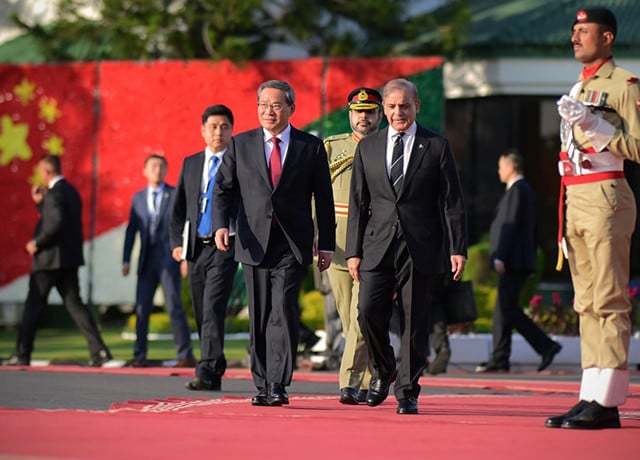
Premier Li’s arrival at Islamabad’s Noor Khan Airbase was met with full honors. In a show of deep respect and friendship, Prime Minister Shehbaz Sharif personally greeted the Chinese leader, accompanied by a floral welcome and a ceremonial 21-gun salute. The visit, Premier Li’s first official trip to Pakistan as China’s head of government, is seen as a significant diplomatic gesture, reinforcing the two countries’ “all-weather” friendship.
At the Prime Minister’s House, a formal reception took place with the national anthems of both countries played, followed by a guard of honor from Pakistan’s armed forces. Premier Li and Prime Minister Sharif then sat down for a working luncheon, where talks centered around expanding bilateral cooperation, with both leaders reaffirming the importance of their strategic partnership.
Pushing Forward the CPEC Agenda
The delegation-level talks that followed were a crucial aspect of the visit. Both leaders discussed key bilateral, regional, and global issues, with a particular focus on the continued success of CPEC. Since its launch, CPEC has drawn both praise and controversy, hailed as a cornerstone of Pakistan’s economic future while also being criticized for increasing Pakistan’s debt to China. Despite these challenges, the project remains central to Pakistan’s development strategy.
Premier Li and Prime Minister Sharif reaffirmed their commitment to completing CPEC’s second phase, which will focus on industrialization, agricultural modernization, information technology, and scientific advancements. “CPEC is not just a project; it’s a transformative journey for Pakistan,” Premier Li emphasized. He added that the timely completion of ongoing projects is critical for unlocking Pakistan’s true economic potential.
CPEC, a key element of China’s ambitious Belt and Road Initiative (BRI), aims to connect the deep-sea port of Gwadar with China’s Xinjiang region through a network of highways, railways, and pipelines. This connectivity is expected to create an economic corridor that could serve as a major conduit for trade between China, the Middle East, and Africa. Pakistan, in turn, hopes to see significant benefits in terms of job creation, infrastructure development, and increased foreign investment.
Security Concerns and Economic Cooperation
One of the most pressing issues on the agenda was security. Recent terrorist attacks targeting Chinese nationals working on CPEC projects have raised concerns, especially after the Karachi bombing earlier this month, which left two Chinese engineers dead. These attacks, perpetrated by separatist groups opposed to foreign investments in the region, have tested the resilience of the Pakistan-China relationship.
Despite these threats, both nations have made it clear that they will not be deterred. Prime Minister Sharif reassured Premier Li of Pakistan’s “unwavering commitment” to ensure the safety of Chinese nationals and projects. As part of these efforts, discussions during the visit included the possibility of establishing a joint security force to protect Chinese workers and CPEC infrastructure. Diplomatic sources suggest that China may propose the creation of a specialized security company to safeguard these high-priority projects.
Economic cooperation was another major theme of the talks. The two leaders explored strategies for increasing Chinese investments in Pakistan, particularly in industrial sectors. Pakistan is keen to attract Chinese industries to relocate to its Special Economic Zones (SEZs) under CPEC, which could boost local manufacturing and reduce trade imbalances. Moreover, discussions included ways to alleviate Pakistan’s crippling power sector debts, which have been exacerbated by CPEC energy projects.
Strengthening Bilateral Ties Across the Board
The signing of several MoUs across various sectors, including trade, infrastructure, energy, and technology, underscored the broad scope of Pakistan-China cooperation. These agreements are expected to bolster economic ties and provide a framework for further development, with a particular focus on sectors that can drive long-term growth for Pakistan.
Premier Li expressed optimism about the future of Pakistan-China relations. “Our friendship is as strong as ever,” he remarked, referring to Pakistan as China’s “iron brother.” He highlighted that despite challenges, the two countries have continued to support each other on core issues, from economic cooperation to security and regional stability.
The visit comes at a crucial time for Pakistan, as the country faces severe economic and political turmoil. With inflation soaring and political uncertainty threatening future stability, Pakistan is looking to China as a key partner in its recovery efforts. Premier Li’s visit, accompanied by senior Chinese officials from the foreign, trade, and development ministries, is expected to help strengthen Pakistan’s economic standing, particularly through new investments and support for ongoing projects under CPEC.
Looking Ahead: A Renewed Focus on CPEC’s Future
Premier Li’s visit is expected to conclude with the soft launch of Gwadar International Airport and other significant agreements that will define the future trajectory of Pakistan-China relations. The leaders’ shared vision for economic growth and stability in the region promises to usher in a new era of cooperation.
With CPEC entering a critical phase, the success of projects like Gwadar International Airport is vital for the long-term goals of both countries. For Pakistan, the completion of these projects represents a chance to transform its economic landscape, while for China, CPEC serves as a critical node in its global Belt and Road Initiative. The next steps in this ambitious partnership will be closely watched by regional and global observers alike.