
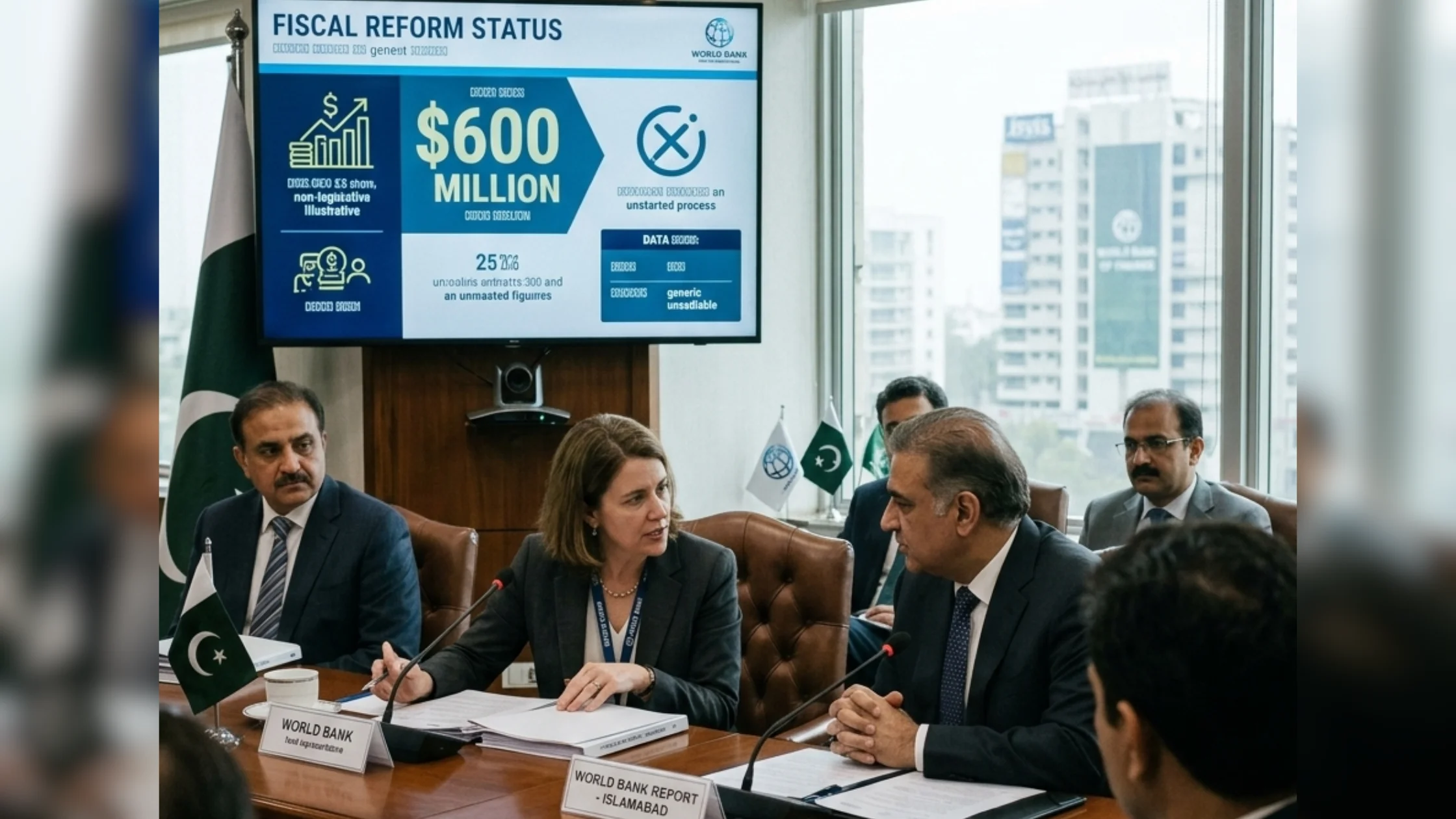
Pakistan’s $600 million fiscal reform programme, supported by the World Bank, has yet to begin implementation months after its approval, raising concerns over delays in key administrative processes.
The programme, titled “Pakistan Public Resources for Inclusive Development,” was approved on December 19, 2025. However, it remains inactive as its planning document (PC-1) is still awaiting clearance from the Central Development Working Party. As a result, no funds have been disbursed and no practical work has started so far.
Despite the lack of progress, the World Bank has rated the programme’s overall status as “Moderately Satisfactory,” while assigning a “Substantial” risk level due to political, economic, and institutional challenges.
The reform initiative is designed to strengthen Pakistan’s economy by improving revenue collection, enhancing public spending efficiency, and upgrading national statistical systems. Key targets include increasing the tax-to-GDP ratio from 12.3% to 15% by 2030, reducing tax exemptions by 30%, and increasing the share of direct taxes in overall revenue. However, all these indicators remain unchanged due to the delay.
World Bank Announces $1.35 Billion Financial Support Package for Pakistan
Efforts to modernize tax administration, such as launching a unified GST portal and expanding the tax base, have been slowed by coordination issues between federal and provincial authorities. Similarly, planned reforms on the expenditure side—like digitizing vendor payments and expanding e-governance services—have not yet begun.
The report also highlighted delays in broader structural reforms, including the government’s rightsizing plan, which is still awaiting cabinet approval. Measures to reduce power sector subsidies, currently estimated at Rs1.19 trillion annually, are also stuck at the planning stage.
Institutional challenges are another major hurdle. Key positions in the Project Management Unit, including the director and technical staff, have not yet been filled. In addition, governance systems related to procurement and auditing are still under development.
The programme also aims to improve Pakistan’s statistical performance, with a target to raise its score significantly and establish modern data systems. However, no progress has been recorded in this area either.
The World Bank is expected to conduct its first implementation review later this year. Until then, the programme remains in a preparatory phase, dependent on approvals and institutional readiness before it can move forward.