
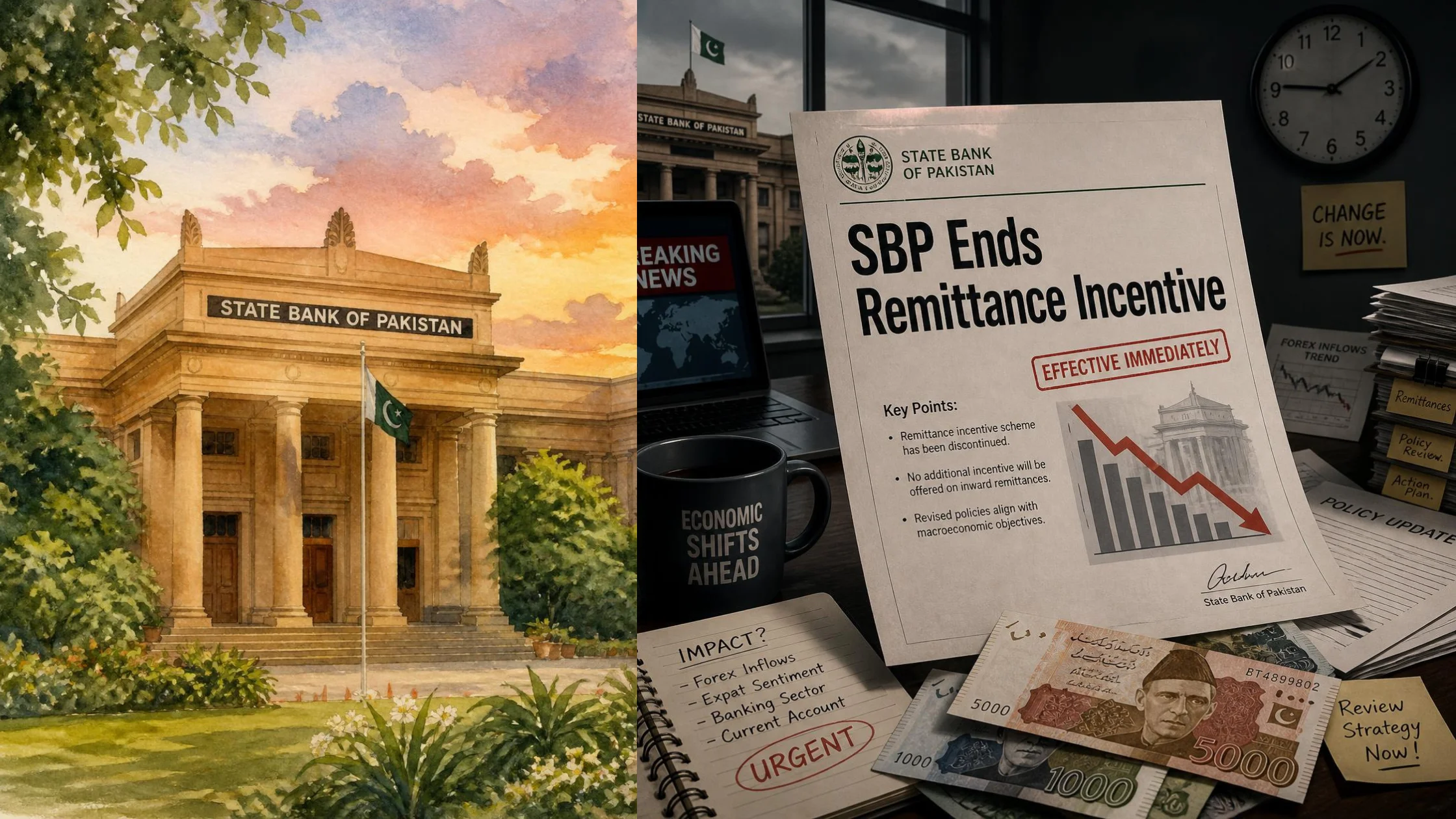
In a major policy shift aimed at reducing fiscal costs and aligning with the International Monetary Fund’s (IMF) reform agenda, the State Bank of Pakistan (SBP) has abolished two key incentive schemes linked to home remittances. The decision, effective July 1, 2026, marks the end of the Sohni Dharti Remittance Programme (SDRP) and the Telegraphic Transfer Charges Incentive Scheme (TTCIS).
The move comes after the growing financial burden of the schemes drew IMF attention, with banking industry sources estimating that the TTCIS alone cost the government between Rs100 billion and Rs120 billion annually.
SBP Discontinues SDRP Rewards Programme
Under the Sohni Dharti Remittance Programme, overseas Pakistanis earned reward points for sending money through official banking channels. The SBP has announced that no new reward points will be issued for remittances sent from July 1, 2026.
However, remitters who accumulated points until June 30, 2026, can still redeem them until June 30, 2027, after which the programme will be permanently closed.
The initiative was introduced to encourage overseas Pakistanis to use formal banking channels instead of informal money transfer systems.
Banks Lose Incentive Payments, Free Remittance Services to Continue

The central bank has also withdrawn the Telegraphic Transfer Charges Incentive Scheme (TTCIS), under which banks received financial incentives for processing eligible remittance transactions.
Despite the scheme’s closure, the SBP has clarified that banks will continue providing eligible remittance services free of charge to both overseas senders and beneficiaries in Pakistan.
According to banking officials, advances in digital payment technologies and automated transfer systems significantly reduced banks’ processing costs, making the continuation of incentive payments increasingly difficult to justify.
IMF Pushes for Cost-Cutting Measures
Banking sector sources say the IMF questioned the continuation of the TTCIS because payments to banks were no longer closely linked to their operational performance. With digital remittance platforms becoming more efficient, the fund reportedly viewed the scheme as an unnecessary fiscal expense.
The government’s decision reflects its broader commitment to reducing non-essential expenditures while maintaining financial sector stability under ongoing IMF-supported economic reforms.
Pakistan’s economy shows signs of recovery amid govt reforms, IMF deal: SBP
SBP’s foreign reserves hit 32-month high
Senate Committee Calls on SBP to End Mandatory Abaya Requirement for Female Bank Employees
More Than 20,000 Women Entrepreneurs Receive Rs. 24 Billion in Loans from Banks: SBP
Pakistan Remittance Initiative Remains Unchanged
The latest decision does not affect the Pakistan Remittance Initiative (PRI), which continues to operate as the country’s primary framework for facilitating overseas remittances.
Industry sources say commercial banks still earn substantial income through the PRI, although official figures have not been disclosed.
Remittance Growth Remains Strong
The policy change comes at a time when Pakistan is witnessing record remittance inflows.
Workers’ remittances reached approximately $40 billion during FY2024-25, driven by higher overseas employment and stronger inflows from Gulf countries. Analysts project remittances could rise further to between $41 billion and $42 billion in FY2025-26, reinforcing their role as one of Pakistan’s most important sources of foreign exchange.
What the Decision Means
While overseas Pakistanis will no longer receive new SDRP reward points, they can continue sending money through formal banking channels without paying transfer charges. For banks, the removal of incentive payments may reduce a significant revenue stream, but the continued growth in remittance volumes is expected to support transaction-based earnings.
For the government, discontinuing the schemes could help lower public spending while addressing IMF concerns over costly subsidy-like programmes. The long-term impact will depend on whether formal remittance inflows remain resilient without these financial incentives.